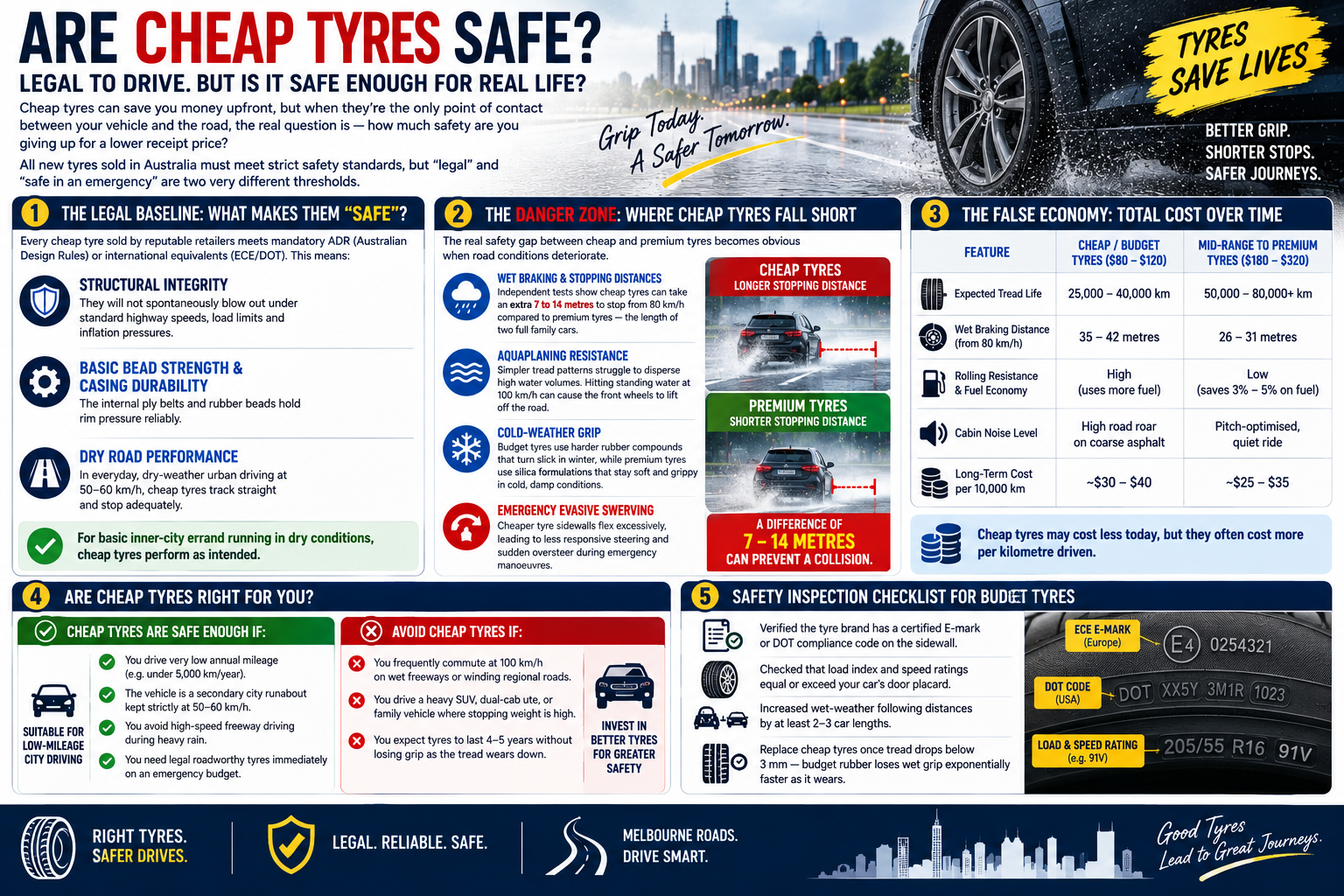
When facing tyre replacement costs, cheap budget tyres priced around $80 to $110 per corner look like an easy way to save money. But when a set of four tyres is the only point of contact connecting your vehicle to the tarmac, how much safety are you giving up for a lower receipt price?
All new tyres legally sold in Australia and across major regulated markets must satisfy baseline national safety and design standards. However, "legal" and "safe in an emergency" are two very different thresholds.
1. The Legal Baseline: What Makes Them "Safe"
Every cheap tyre sold by reputable retail chains meets mandatory ADR (Australian Design Rules) or international equivalents (ECE/DOT):
- Structural Integrity: They will not spontaneously blow out under standard highway speeds, load limits, and inflation pressures.
- Basic Bead Strength & Casing Durability: The internal ply belts and rubber beads hold rim pressure reliably.
- Dry Road Performance: In everyday, dry-weather urban driving at 50–60 km/h, cheap tyres track straight and stop adequately.
For basic inner-city errand running in dry conditions, cheap tyres perform as intended.
2. The Danger Zone: Where Cheap Tyres Fall Short
The real safety gap between cheap rubber and premium brands becomes obvious the moment road conditions deteriorate:
- Wet Braking & Stopping Distances: Independent braking tests from 80 km/h to 0 km/h show that cheap budget tyres take an extra 7 to 14 metres to bring a car to a full stop compared to premium tyres. That gap is the length of two full family cars.
- Aquaplaning Resistance: Cheap tyres use simpler, directional or symmetrical tread patterns that struggle to disperse high water volumes. Hitting standing water at 100 km/h on a freeway can easily cause the front wheels to lift off the road.
- Cold-Weather Grip: Premium tyres use micro-silica formulations that stay soft and malleable in winter rain. Cheap tyres rely on hard, carbon-black rubber mixes that turn slick and skate over damp tarmac.
- Emergency Evasive Swerving: During a sudden lane change to avoid an obstacle, budget tyre sidewalls flex excessively, triggering sudden snap-oversteer or unresponsive steering.
3. The False Economy: Total Cost Over Time
Cheap tyres often end up costing more per kilometre driven:
| Feature | Cheap / Budget Tyres ($80 – $120) | Mid-Range to Premium Tyres ($180 – $320) |
|---|---|---|
| Expected Tread Life | 25,000 – 40,000 km | 50,000 – 80,000+ km |
| Wet Braking Distance (from 80 km/h) | 35 – 42 metres | 26 – 31 metres |
| Rolling Resistance & Fuel Economy | High (uses more fuel) | Low (saves 3%–5% on fuel) |
| Cabin Noise Level | High road roar on coarse asphalt | Pitch-optimised, quiet ride |
| Long-Term Cost per 10,000 km | ~$30 – $40 | ~$25 – $35 |
Are Cheap Tyres Right for You?
Cheap Tyres Are Safe Enough If:
- You drive very low annual mileage (e.g., under 5,000 km/year).
- The vehicle is a secondary city runabout kept strictly at suburban 50–60 km/h speeds.
- You avoid high-speed freeway commuting during heavy rain.
- You need legal roadworthy tyres immediately on an emergency budget.
Avoid Cheap Tyres If:
- You frequently commute at 100 km/h on wet freeways or winding regional roads.
- You drive a heavy SUV, dual-cab ute, or family vehicle where stopping weight is high.
- You expect tyres to last 4–5 years without losing grip as the tread wears down.
Safety Inspection Checklist for Budget Tyres
- Verified the tyre brand has a certified E-mark or DOT compliance code on the sidewall.
- Checked that load index and speed ratings equal or exceed your car's door placard.
- Increased wet-weather following distances by at least 2–3 car lengths.
- Replaced cheap tyres once tread drops below 3 mm—budget rubber loses wet grip exponentially faster than premium tyres as it wears.