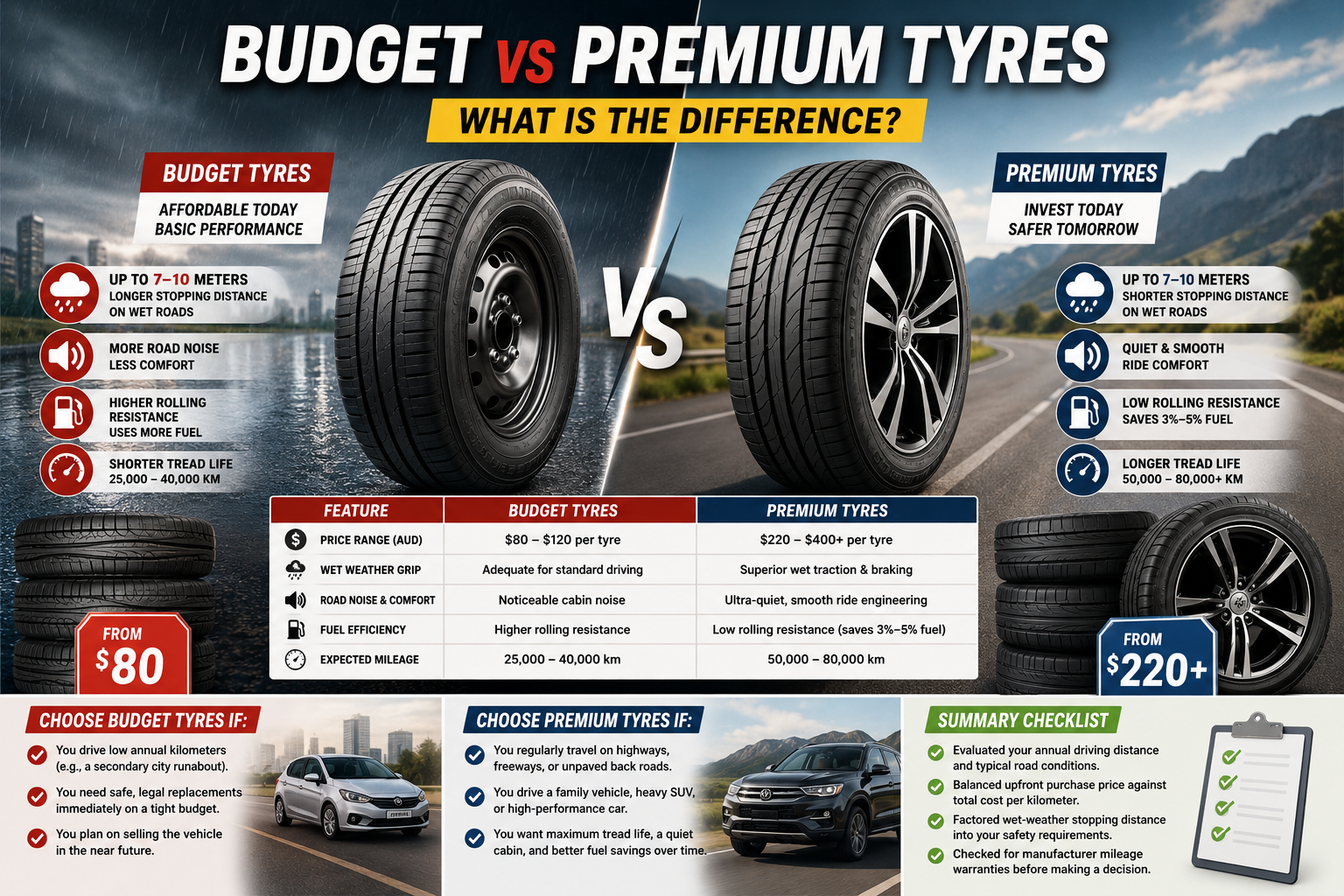
When it comes time to replace your tyres, the price gap between budget and premium brands can be staggering. You might find a budget tyre for $80, while a premium alternative from a top brand costs $250 or more. But what are you actually paying for, and is the extra investment really worth it?
Understanding the key differences between budget and premium tyres helps you make a safer, more cost-effective choice for your daily driving needs.
1. Rubber Compound & Materials
The biggest distinction between price tiers lies in the technology and raw materials used to create the rubber compound:
- Premium Tyres: Built using advanced silica compounds, synthetic polymers, and highly engineered tread designs. These materials allow the tyre to remain flexible in varying temperatures, maximizing traction without wearing down quickly.
- Budget Tyres: Use simpler, standard rubber compounds. While they meet all mandatory legal safety standards, they lack the high-tech chemical formulations that provide optimal grip and longevity.
2. Wet Weather Braking & Safety
Safety is where the performance gap becomes most critical. Premium manufacturers invest hundreds of millions of dollars into wet-grip research and specialized hydroplaning tread patterns.
Stopping Distance Comparison: In independent wet-braking tests from 80 km/h, premium tyres can stop a vehicle up to 7 to 10 meters shorter than basic budget tyres. That distance is often the difference between a safe stop and a severe collision.
3. Tread Lifespan & Long-Term Value
While budget tyres save money upfront, premium tyres often provide better long-term value due to tread durability:
- Budget Tyres: Typically last between 25,000 km and 40,000 km depending on road conditions and driving style.
- Premium Tyres: Regularly deliver 50,000 km to 80,000+ km of tread life while maintaining consistent grip levels throughout their lifespan.
Direct Comparison: Budget vs. Premium
| Feature | Budget Tyres | Premium Tyres |
|---|---|---|
| Price Range (AUD) | $80 – $120 per tyre | $220 – $400+ per tyre |
| Wet Weather Grip | Adequate for standard driving | Superior wet traction & braking |
| Road Noise & Comfort | Noticeable cabin noise | Ultra-quiet, smooth ride engineering |
| Fuel Efficiency | Higher rolling resistance | Low rolling resistance (saves 3%–5% fuel) |
| Expected Mileage | 25,000 – 40,000 km | 50,000 – 80,000 km |
Which Should You Choose?
Choose Budget Tyres if:
- You drive low annual kilometers (e.g., a secondary city runabout).
- You need safe, legal replacements immediately on a tight budget.
- You plan on selling the vehicle in the near future.
Choose Premium Tyres if:
- You regularly travel on highways, freeways, or unpaved back roads.
- You drive a family vehicle, heavy SUV, or high-performance car.
- You want maximum tread life, a quiet cabin, and better fuel savings over time.
Summary Checklist
- Evaluated your annual driving distance and typical road conditions.
- Balanced upfront purchase price against total cost per kilometer.
- Factored wet-weather stopping distance into your safety requirements.
- Checked for manufacturer mileage warranties before making a decision.