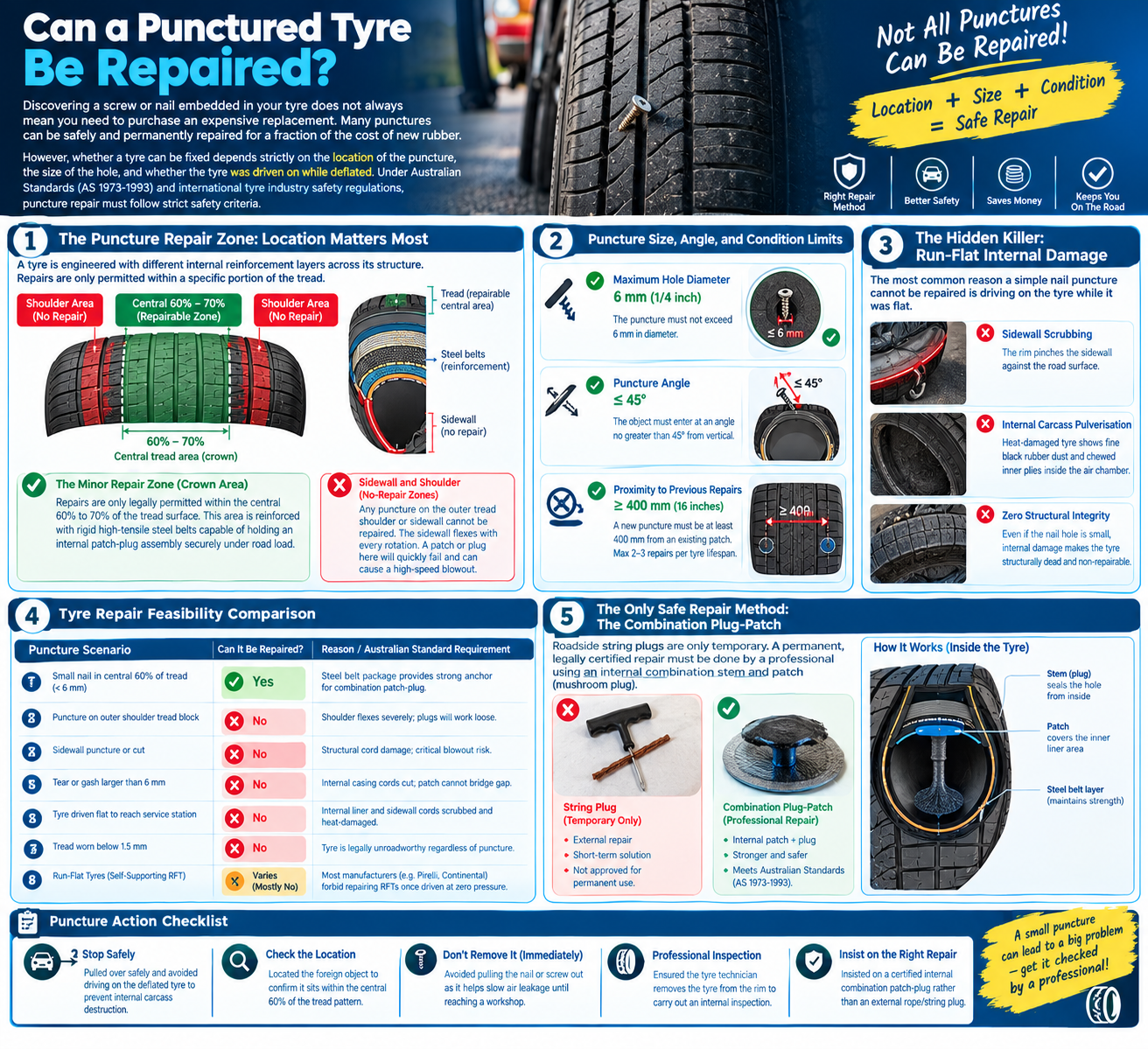
Discovering a screw or nail embedded in your tyre does not always mean you need to purchase an expensive replacement. Many punctures can be safely and permanently repaired for a fraction of the cost of new rubber.
However, whether a tyre can be fixed depends strictly on the location of the puncture, the size of the hole, and whether the tyre was driven on while deflated. Under Australian Standards (AS 1973-1993) and international tyre industry safety regulations, puncture repair must follow strict safety criteria.
1. The Puncture Repair Zone: Location Matters Most
A tyre is engineered with different internal reinforcement layers across its structure. For safety reasons, repairs are only permitted within a specific portion of the tread:
- The Minor Repair Zone (Crown Area): Repairs are only legally permitted within the central 60% to 70% of the tread surface (the crown), which is reinforced with rigid high-tensile steel belts capable of holding an internal patch-plug assembly securely under road load.
- The Sidewall and Shoulder (No-Repair Zones): Any puncture located on the outer tread shoulder or flexible sidewall cannot be repaired. The sidewall undergoes continuous cyclical flexing with every wheel rotation, meaning a patch or plug applied here will quickly separate and trigger a catastrophic blowout.
2. Puncture Size, Angle, and Condition Limits
- Maximum Hole Diameter (6 mm): The puncture channel created by a foreign object must not exceed 6 mm (1/4 inch) in diameter. Larger cuts or gashes cannot be reliably sealed.
- Puncture Angle: The penetrating object must have entered at an angle no greater than 45 degrees from vertical to avoid shearing adjacent steel belt plies.
- Proximity & Tread Depth: A new puncture must be at least 400 mm away from an existing patch, and the tyre must have legal tread remaining (at least 1.5 mm legally, though many shops require 2 mm to 3 mm).
3. The Hidden Killer: Run-Flat Internal Damage
Driving even a few hundred metres on an under-inflated or completely flat tyre forces the rim to pinch the sidewall against the road surface. When dismounted, a heat-damaged tyre reveals fine black rubber dust and chewed inner plies. Even if the nail hole is small, internal sidewall delamination makes the tyre structurally dead and strictly non-repairable.
Tyre Repair Feasibility Comparison
| Puncture Scenario | Can It Be Safely Repaired? | Reason / Australian Standard Requirement |
|---|---|---|
| Small nail in central 60% of tread (< 6 mm) | Yes | Steel belt package provides strong anchor for combination patch-plug. |
| Puncture on the outer shoulder tread block | No | Shoulder experiences severe cornering flex; plugs will work loose. |
| Sidewall puncture or cut | No | Structural cord damage; critical blowout risk under vehicle load. |
| Tear or gash larger than 6 mm | No | Internal casing cords cut; patch cannot bridge structural gap. |
| Tyre driven flat to reach a service station | No | Internal liner and sidewall cords scrubbed and heat-damaged. |
| Tread worn below 1.5 mm | No | Tyre is legally unroadworthy regardless of the puncture. |
| Run-Flat Tyres (Self-Supporting RFT) | Varies (Mostly No) | Most manufacturers forbid repairing RFTs once driven at zero pressure. |
4. The Only Safe Repair Method: The "Combination Plug-Patch"
Roadside emergency string plugs are intended only as temporary measures. A permanent, legally certified repair requires a tyre professional to demount the tyre, clean the channel, treat the inner liner with vulcanising cement, and insert an internal combination stem and patch (mushroom plug) from the inside out.
Puncture Action Checklist
- Pulled over safely and avoided driving on the deflated tyre to prevent internal carcass destruction.
- Located the foreign object to confirm it sits within the central 60% of the tread pattern.
- Avoided pulling the nail or screw out immediately, as it helps slow air leakage until reaching a workshop.
- Ensured the tyre technician removes the tyre from the rim to carry out an internal inspection.
- Insisted on a certified internal combination patch-plug rather than an external rope/string plug.