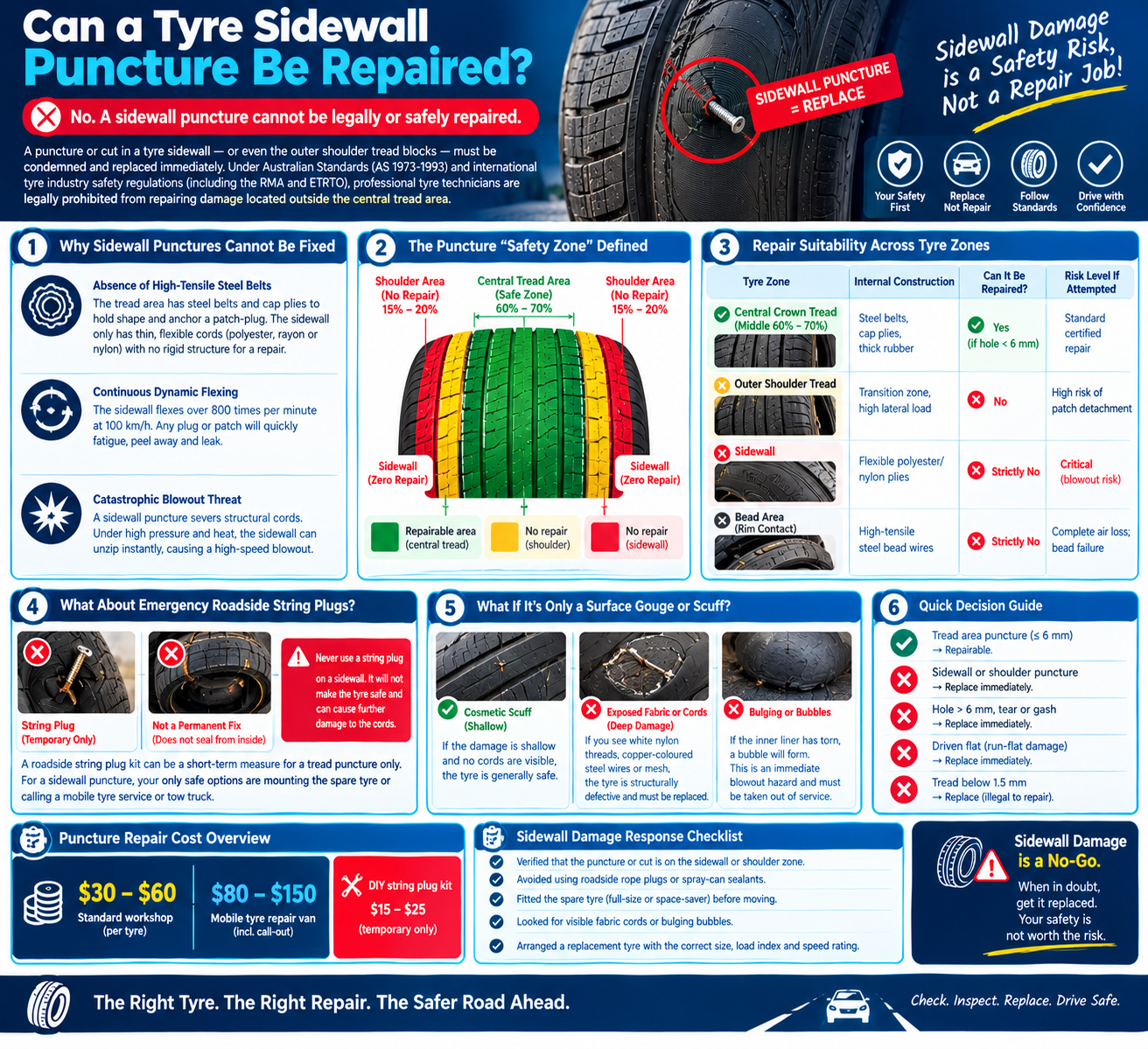
No. A puncture or cut in a tyre sidewall cannot be legally or safely repaired. If a screw, nail, or sharp road debris pierces the sidewall—or even the outer shoulder tread blocks—the tyre must be condemned and replaced immediately.
Under Australian Standards (AS 1973-1993) and international tyre industry safety regulations (including the RMA and ETRTO), professional tyre technicians are legally prohibited from repairing damage located outside the central tread area.
1. Why Sidewall Punctures Cannot Be Fixed
The inability to fix a sidewall puncture is not a retail sales tactic—it is a matter of structural physics and tyre architecture:
- Absence of High-Tensile Steel Belts: The tread area is reinforced by cross-laid woven steel belts designed to hold shape and anchor an internal patch-plug, whereas the sidewall contains only thin, flexible cords (polyester, rayon, or nylon) encased in rubber, lacking the internal rigid scaffolding required to anchor a repair.
- Continuous Dynamic Flexing: Every time the wheel completes a revolution, the sidewall compresses and rebounds under the car's weight. At 100 km/h, this happens over 800 times per minute, causing any plug or patch applied here to quickly fatigue, peel away, and leak.
- Catastrophic Blowout Threat: When a foreign object penetrates the sidewall, it severs structural carcass cords. Under high inflation pressure and thermal stress, this deficit can cause the sidewall to unzip instantly, resulting in an immediate, high-speed blowout.
2. The Puncture "Safety Zone" Defined
Tyre manufacturers and road transport authorities divide tyres into clear repairable and non-repairable zones:
- The Minor Repair Area (The Safe Zone): The central 60% to 70% of the tread face directly beneath the crown, which is supported by steel belts and can securely hold an internal combination patch-plug.
- The Shoulder Area (No-Repair Zone): The outer 15% to 20% on each edge of the tread. Because this zone absorbs extreme cornering loads, repairs here will work loose.
- The Sidewall (Zero-Repair Zone): The entire vertical span from the shoulder line down to the rim bead where repairs of any kind are strictly prohibited.
Repair Suitability Across Tyre Zones
| Tyre Zone | Internal Construction | Can It Be Repaired? | Risk Level If Attempted |
|---|---|---|---|
| Central Crown Tread (Middle 60%–70%) | Steel belts, cap plies, thick rubber | Yes (if hole < 6 mm) | Standard certified repair |
| Outer Shoulder Tread | Transition zone, high lateral load | No | High risk of patch detachment |
| Sidewall | Flexible polyester/nylon plies | Strictly No | Critical (Catastrophic blowout risk) |
| Bead Area (Rim Contact) | High-tensile steel bead wires | Strictly No | Complete air loss; bead failure |
3. What About Emergency Roadside String Plugs?
Never push an external roadside rope or string plug into a tyre sidewall. It will not make the tyre safe even temporarily; using the rasp tool on a sidewall tears additional structural cords, and if you are stranded, your only safe options are mounting the spare tyre or calling a mobile service or tow truck.
4. What If the Damage Is Only a Surface Gouge or Scuff?
- Cosmetic Scuffs: Kerb scuffs that shave off small outer flakes without exposing cords are generally safe.
- Exposed Fabric or Cords: Slices or tears revealing white nylon threads or steel wires mean the tyre is structurally defective and will fail a roadworthy inspection.
- Visible Bulges or Bubbles: Lumps indicate inner liner failure allowing air to push between structural layers; this is an immediate blowout hazard requiring retirement.
Sidewall Damage Response Checklist
- Verified that the puncture or cut is located on the sidewall or shoulder zone.
- Avoided attempting to use roadside rope plugs or spray-can tyre sealants on the sidewall.
- Fitted the vehicle's spare tyre (full-size or temporary space-saver) before moving the vehicle.
- Looked for visible fabric cords or bulging bubbles along the inner and outer sidewall surfaces.
- Arranged a direct replacement tyre matching the correct size, load index, and speed rating on your door placard.