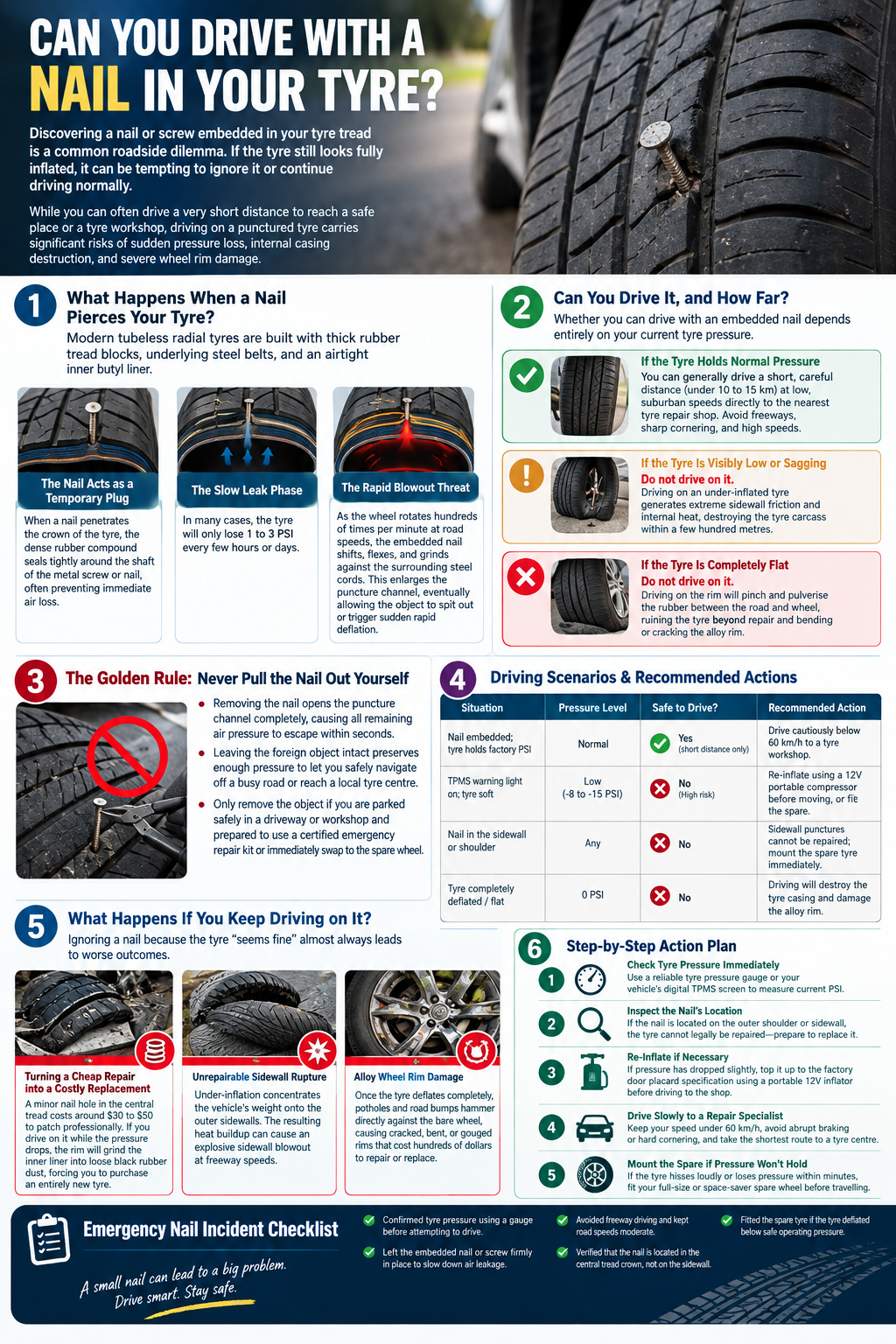
Discovering a nail or screw embedded in your tyre tread is a common roadside dilemma. If the tyre still looks fully inflated, it can be tempting to ignore it or continue driving normally.
While you can often drive a very short distance to reach a safe place or a tyre workshop, driving on a punctured tyre carries significant risks of sudden pressure loss, internal casing destruction, and severe wheel rim damage.
1. What Happens When a Nail Pierces Your Tyre?
Modern tubeless radial tyres are built with thick rubber tread blocks, underlying steel belts, and an airtight inner butyl liner.
- The Nail Acts as a Temporary Plug: When a nail penetrates the crown of the tyre, the dense rubber compound seals tightly around the shaft of the metal screw or nail, often preventing immediate air loss.
- The Slow Leak Phase: In many cases, the tyre will only lose 1 to 3 PSI every few hours or days.
- The Rapid Blowout Threat: As the wheel rotates hundreds of times per minute at road speeds, the embedded nail shifts, flexes, and grinds against the surrounding steel cords, eventually allowing the object to spit out or trigger sudden rapid deflation.
2. Can You Drive It, and How Far?
- If the Tyre Holds Normal Pressure: You can generally drive a short, careful distance (under 10 to 15 km) at low, suburban speeds directly to the nearest tyre repair shop, avoiding freeways and sharp cornering.
- If the Tyre Is Visibly Low or Sagging: Do not drive on it. Driving on an under-inflated tyre generates extreme sidewall friction and internal heat, destroying the tyre carcass within a few hundred metres.
- If the Tyre Is Completely Flat: Driving on the rim will pinch and pulverise the rubber between the road and wheel, ruining the tyre beyond repair and bending or cracking the alloy rim.
3. The Golden Rule: Never Pull the Nail Out Yourself
If you spot a nail or screw in your tyre, leave it in place. Removing the nail opens the puncture channel completely, causing all remaining air pressure to escape within seconds. Leaving the foreign object intact preserves enough pressure to let you safely navigate off a busy road or reach a local tyre centre. Only remove the object if you are parked safely in a driveway or workshop and prepared to use a certified emergency tyre repair kit or immediately swap to the spare wheel.
Driving Scenarios & Recommended Actions
| Situation | Pressure Level | Safe to Drive? | Recommended Immediate Action |
|---|---|---|---|
| Nail embedded; tyre holds factory PSI | Normal | Short distance only (< 15 km) | Drive cautiously below 60 km/h straight to a tyre workshop. |
| TPMS warning light on; tyre soft | Low (-8 to -15 PSI) | No (High risk) | Re-inflate using a 12V portable compressor before moving, or fit the spare. |
| Nail in the tyre sidewall or shoulder | Any | No | Sidewall punctures cannot be repaired; mount the spare tyre immediately. |
| Tyre completely deflated / flat | 0 PSI | Strictly No | Driving will destroy the tyre casing and damage the alloy rim. |
4. What Happens If You Keep Driving on It?
Ignoring a nail because the tyre seems fine almost always turns an inexpensive $30 to $50 central tread patch into a costly replacement. Under-inflation concentrates the vehicle's weight onto the outer sidewalls, creating heat buildup that can cause an explosive blowout at freeway speeds, while a completely deflated tyre hammers directly against the bare wheel, destroying both the casing and the alloy rim.
Emergency Nail Incident Checklist
- Confirmed tyre pressure using a gauge before attempting to drive.
- Left the embedded nail or screw firmly in place to slow down air leakage.
- Avoided freeway driving and kept road speeds moderate.
- Verified that the nail is located in the central tread crown, not on the sidewall.
- Fitted the spare tyre if the tyre deflated below safe operating pressure.