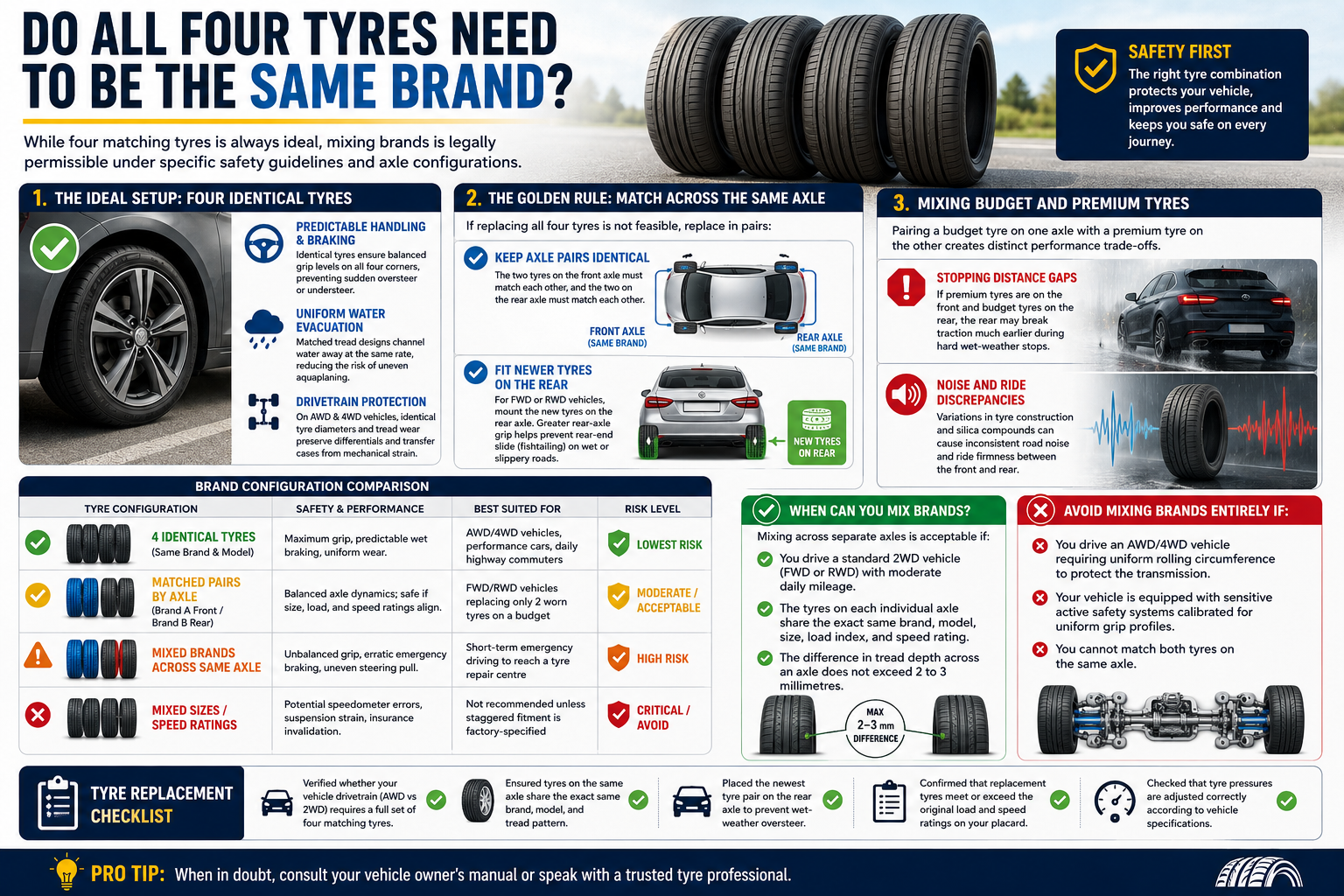
When replacing a worn tyre or repairing an unexpected puncture, replacing only one or two tyres at a time can save money. However, this often raises an important question: is it safe to mix different tyre brands, or do all four wheels need to have identical rubber?
While having four matching tyres is always the ideal setup, mixing brands is legally permissible under specific safety guidelines and axle configurations.
1. The Ideal Setup: Four Identical Tyres
Having identical tyres—same brand, model, size, load rating, and tread pattern—delivers optimal vehicle dynamics:
- Predictable Handling & Braking: Identical tyres ensure balanced grip levels on all four corners, preventing sudden oversteer or understeer during emergency manoeuvres.
- Uniform Water Evacuation: Matched tread designs channel water away at the same rate, reducing the risk of uneven aquaplaning in heavy rain.
- Drivetrain Protection: On All-Wheel Drive (AWD) and 4WD vehicles, identical tyre diameters and tread wear preserve delicate differentials and transfer cases from mechanical strain.
2. The Golden Rule: Match Across the Same Axle
If replacing all four tyres is not feasible, industry standards recommend replacing them in pairs:
- Keep Axle Pairs Identical: Always ensure the two tyres on the front axle match each other, and the two on the rear axle match each other. Mixing different brands, tread patterns, or wear levels across the same axle disrupts steering balance and braking stability.
- Fit Newer Tyres on the Rear: When replacing only two tyres on Front-Wheel Drive or Rear-Wheel Drive cars, mount the new tyres on the rear axle. Greater rear-axle grip prevents rear-end slide (fishtailing) on wet or slippery surfaces.
3. Mixing Budget and Premium Tyres
Pairing a budget tyre on one axle with a premium tyre on the other creates distinct performance trade-offs:
- Stopping Distance Gaps: If premium tyres are on the front and budget tyres on the rear, the rear may break traction much earlier during hard wet-weather stops.
- Noise and Ride Discrepancies: Variations in tyre construction and silica compounds can cause inconsistent road noise and ride firmness between the front and rear of the cabin.
Brand Configuration Comparison
| Tyre Configuration | Safety & Performance | Best Suited For | Risk Level |
|---|---|---|---|
| 4 Identical Tyres (Same Brand & Model) | Maximum grip, predictable wet braking, uniform wear | AWD/4WD vehicles, performance cars, daily highway commuters | Lowest Risk |
| Matched Pairs by Axle (Brand A Front / Brand B Rear) | Balanced axle dynamics; safe if size, load, and speed ratings align | FWD/RWD vehicles replacing only 2 worn tyres on a budget | Moderate / Acceptable |
| Mixed Brands Across Same Axle | Unbalanced grip, erratic emergency braking, uneven steering pull | Short-term emergency driving to reach a tyre repair centre | High Risk |
| Mixed Sizes / Speed Ratings | Potential speedometer errors, suspension strain, insurance invalidation | Not recommended unless staggered fitment is factory-specified | Critical / Avoid |
When Can You Mix Brands?
Mixing across separate axles is acceptable if:
- You drive a standard 2WD vehicle (FWD or RWD) with moderate daily mileage.
- The tyres on each individual axle share the exact same brand, model, size, load index, and speed rating.
- The difference in tread depth across an axle does not exceed 2 to 3 millimetres.
Avoid mixing brands entirely if:
- You drive an AWD/4WD vehicle requiring uniform rolling circumference to protect the transmission.
- Your vehicle is equipped with sensitive active safety systems calibrated for uniform grip profiles.
- You cannot match both tyres on the same axle.
Tyre Replacement Checklist
- Verified whether your vehicle drivetrain (AWD vs 2WD) requires a full set of four matching tyres.
- Ensured tyres on the same axle share the exact same brand, model, and tread pattern.
- Placed the newest tyre pair on the rear axle to prevent wet-weather oversteer.
- Confirmed that replacement tyres meet or exceed the original load and speed ratings on your placard.
- Checked that tyre pressures are adjusted correctly according to vehicle specifications.