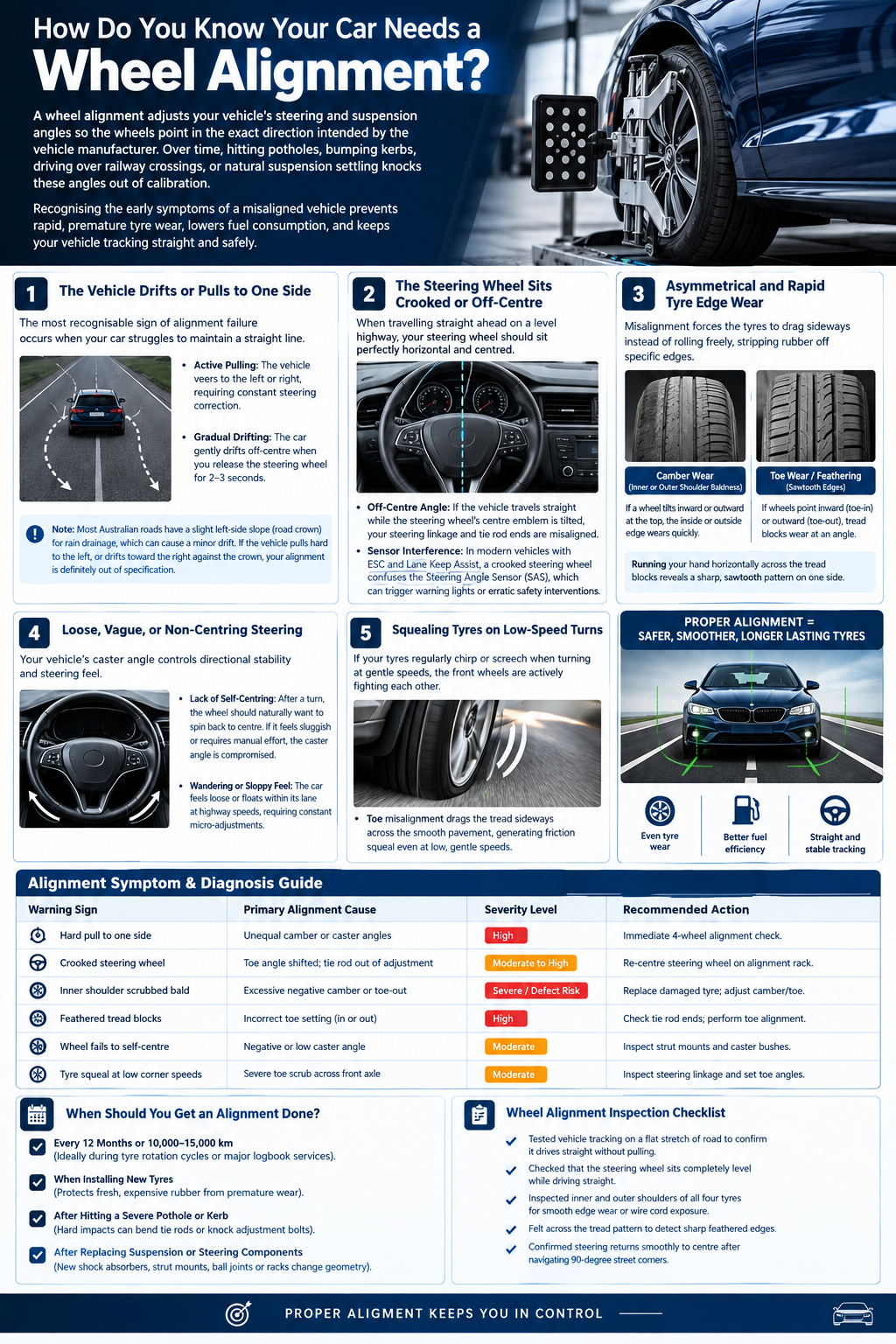
A wheel alignment adjusts your vehicle's steering and suspension angles so the wheels point in the exact direction intended by the vehicle manufacturer. Over time, striking potholes, bumping concrete kerbs, driving over railway crossings, or natural suspension component settling knocks these angles out of calibration.
Recognising the early symptoms of a misaligned vehicle prevents rapid, premature tyre wear, lowers fuel consumption, and keeps your vehicle tracking straight and safely.
1. The Vehicle Drifts or Pulls to One Side
The most recognisable sign of alignment failure occurs when your car struggles to maintain a straight line:
- Active Pulling: On a flat, straight road with little road camber, the vehicle aggressively veers to the left or right, requiring constant steering correction.
- Gradual Drifting: The car gently drifts off-centre when you release firm grip pressure on the wheel for two to three seconds.
- Road Crown Note: Most Australian roads feature a slight left-side slope for drainage. If the vehicle pulls hard to the left, or drifts toward the right against the crown, your alignment is out of specification.
2. The Steering Wheel Sits Crooked or Off-Centre
When travelling straight ahead on a level highway, your vehicle’s steering wheel should sit perfectly horizontal and centred. If it is tilted by several degrees to the left or right, your steering linkage and tie rod ends are misaligned, which can also confuse Electronic Stability Control (ESC) sensors.
3. Asymmetrical and Rapid Tyre Edge Wear
- Camber Wear: If a wheel tilts inward or outward at the top, the inside or outside shoulder scrubs away quickly while the opposing shoulder remains thick.
- Toe Wear / Feathering: If wheels point inward or outward relative to the centreline, tread blocks wear down at an angle, creating a sharp, sawtooth pattern when running your hand across the tread.
Wheel Alignment Symptom & Diagnosis Guide
| Warning Sign | Primary Alignment Cause | Severity Level | Recommended Action |
|---|---|---|---|
| Hard pull to one side | Unequal camber or caster angles | High | Immediate 4-wheel alignment check. |
| Crooked steering wheel | Toe angle shifted; tie rod out of adjustment | Moderate to High | Re-centre steering wheel on alignment rack. |
| Inner shoulder scrubbed bald | Excessive negative camber or toe-out | Severe / Defect Risk | Replace damaged tyre; adjust camber/toe. |
| Feathered tread blocks | Incorrect toe setting (in or out) | High | Check tie rod ends; perform toe alignment. |
| Wheel fails to self-centre | Negative or low caster angle | Moderate | Inspect strut mounts and caster bushes. |
| Tyre squeal at low corner speeds | Severe toe scrub across front axle | Moderate | Inspect steering linkage and set toe angles. |
When Should You Get an Alignment Done?
- Every 12 Months or 10,000–15,000 km: Ideally aligned during regular tyre rotations or logbook services.
- When Installing New Tyres: Protects fresh, expensive rubber from premature wear.
- After Hitting a Pothole or Kerb: Hard impacts frequently bend tie rods or knock adjustment bolts out of place.
- After Suspension Repairs: Installing new struts, ball joints, or steering racks changes geometry.
Wheel Alignment Inspection Checklist
- Tested vehicle tracking on a flat stretch of road to confirm it drives straight without pulling.
- Checked that the steering wheel sits completely level while driving straight.
- Inspected inner and outer shoulders of all four tyres for smooth edge wear or wire cord exposure.
- Felt across the tread pattern to detect sharp feathered edges.
- Confirmed steering returns smoothly to centre after navigating 90-degree street corners.