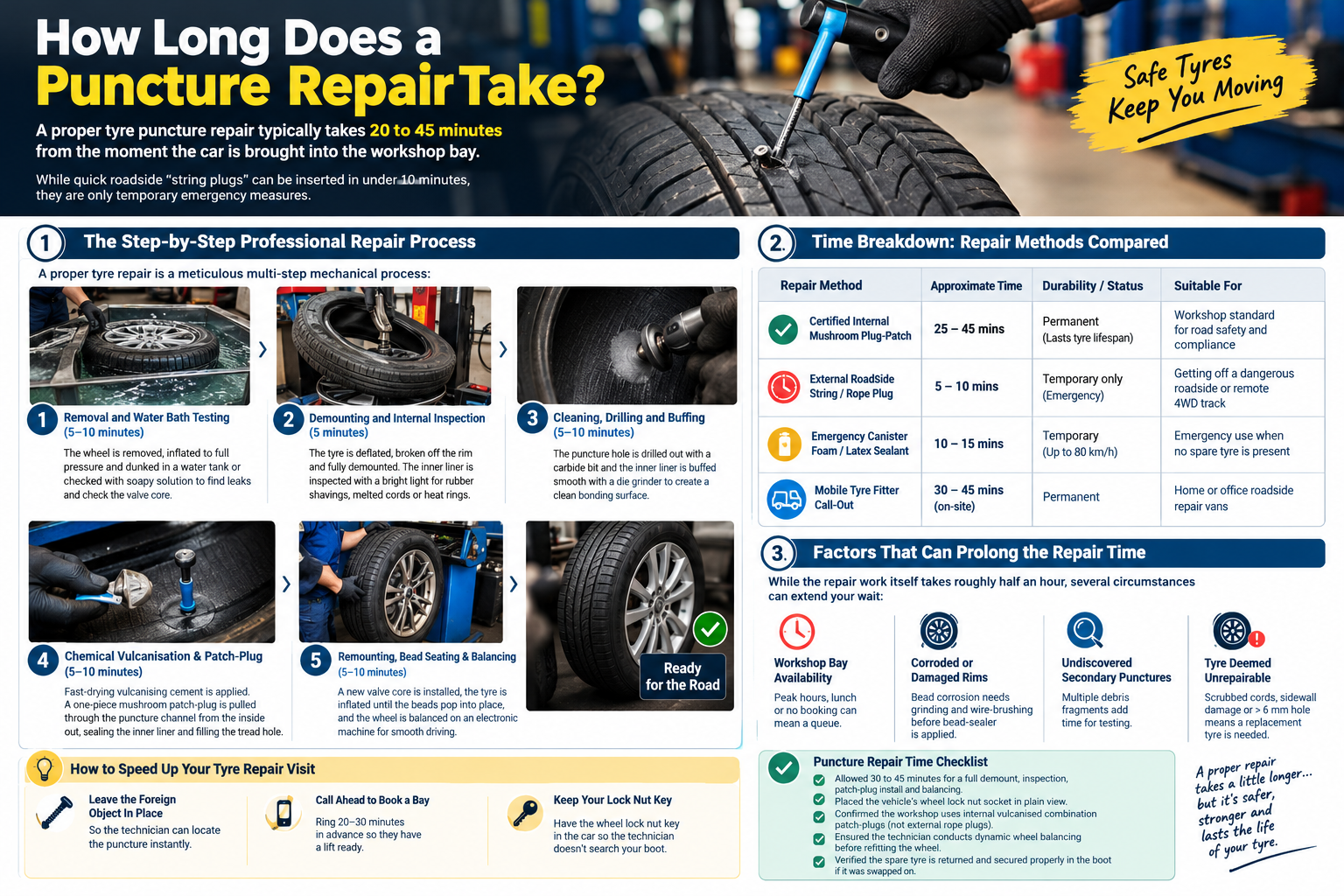
A professional tyre puncture repair typically takes between 20 to 45 minutes from the moment the car is brought into the workshop bay. While quick roadside "string plugs" can be inserted from the outside in under 10 minutes, they are only temporary emergency measures.
A permanent, legally certified repair under Australian Standards (AS 1973-1993) requires demounting the tyre to inspect the inner casing, preparing the puncture channel, and vulcanising an internal patch-plug assembly.
1. The Step-by-Step Professional Repair Process
A proper tyre repair is a meticulous multi-step mechanical process:
- Removal and Water Bath Testing (5–10 minutes): The technician removes the wheel, inflates it to full pressure, and dunks it in a water submersion tank or sprays soapy leak detector to locate every puncture source and check for leaky valve cores.
- Demounting and Internal Inspection (5 minutes): The tyre is deflated, broken off the wheel bead, and fully demounted using a tyre-changing machine. The technician inspects the inner butyl liner with a bright light to check for loose black rubber shavings, melted cords, or heat rings caused by driving while flat.
- Cleaning, Drilling, and Buffing (5–10 minutes): The puncture hole is drilled out with a carbide bit to clear damaged steel belt wires. The technician then mechanically buffs the inner liner smooth with a low-speed die grinder to create a porous, clean bonding surface.
- Chemical Vulcanisation & Patch-Plug Installation (5–10 minutes): Fast-drying chemical vulcanising cement is applied. A one-piece combination "mushroom" patch-plug is pulled through the puncture channel from the inside out, sealing the inner liner while the stem fills the outer tread hole.
- Remounting, Bead Seating & High-Speed Dynamic Balancing (5–10 minutes): A new rubber valve core is installed, the tyre is inflated until the beads pop into place, and the wheel is placed onto an electronic dynamic balancing machine. Counterweights are applied to ensure smooth driving without steering vibrations.
2. Time Breakdown: Repair Methods Compared
| Repair Method | Approximate Time | Durability / Status | Suitable For |
|---|---|---|---|
| Certified Internal Mushroom Plug-Patch | 25 – 45 mins | Permanent (Lasts tyre lifespan) | Workshop standard for road safety and compliance |
| External Roadside String / Rope Plug | 5 – 10 mins | Temporary only (Emergency) | Getting off a dangerous roadside or remote 4WD track |
| Emergency Canister Foam / Latex Sealant | 10 – 15 mins | Temporary (Up to 80 km/h) | Emergency use when no spare tyre is present |
| Mobile Tyre Fitter Call-Out | 30 – 45 mins (on-site) | Permanent | Home or office roadside repair vans |
3. Factors That Can Prolong the Repair Time
While the repair work itself takes roughly half an hour, several circumstances can extend your wait:
- Workshop Bay Availability: Arriving during peak Saturday mornings, lunch hours, or without a booking can mean waiting in the queue before a technician begins work.
- Corroded or Damaged Alloy Rims: If the leak was caused by bead corrosion rather than a direct nail puncture, the technician must grind and wire-brush the inner rim surface before applying bead-sealer compound.
- Undiscovered Secondary Punctures: If the tyre collected multiple sharp debris fragments on the road, testing each leak site adds time.
- Tyre Deemed Unrepairable: If the internal inspection uncovers scrubbed cords, sidewall damage, or an oversized puncture hole (> 6 mm), sourcing and fitting a replacement tyre will be required.
Puncture Repair Time Checklist
- Allowed 30 to 45 minutes for a full demount, internal inspection, patch-plug install, and balancing.
- Placed the vehicle's wheel lock nut socket in plain view for the technician.
- Confirmed the workshop uses internal vulcanised combination patch-plugs rather than external rope plugs.
- Ensured the technician conducts dynamic wheel balancing before refitting the wheel to the hub.
- Verified that the spare tyre is returned and secured properly in the boot if it was swapped on.