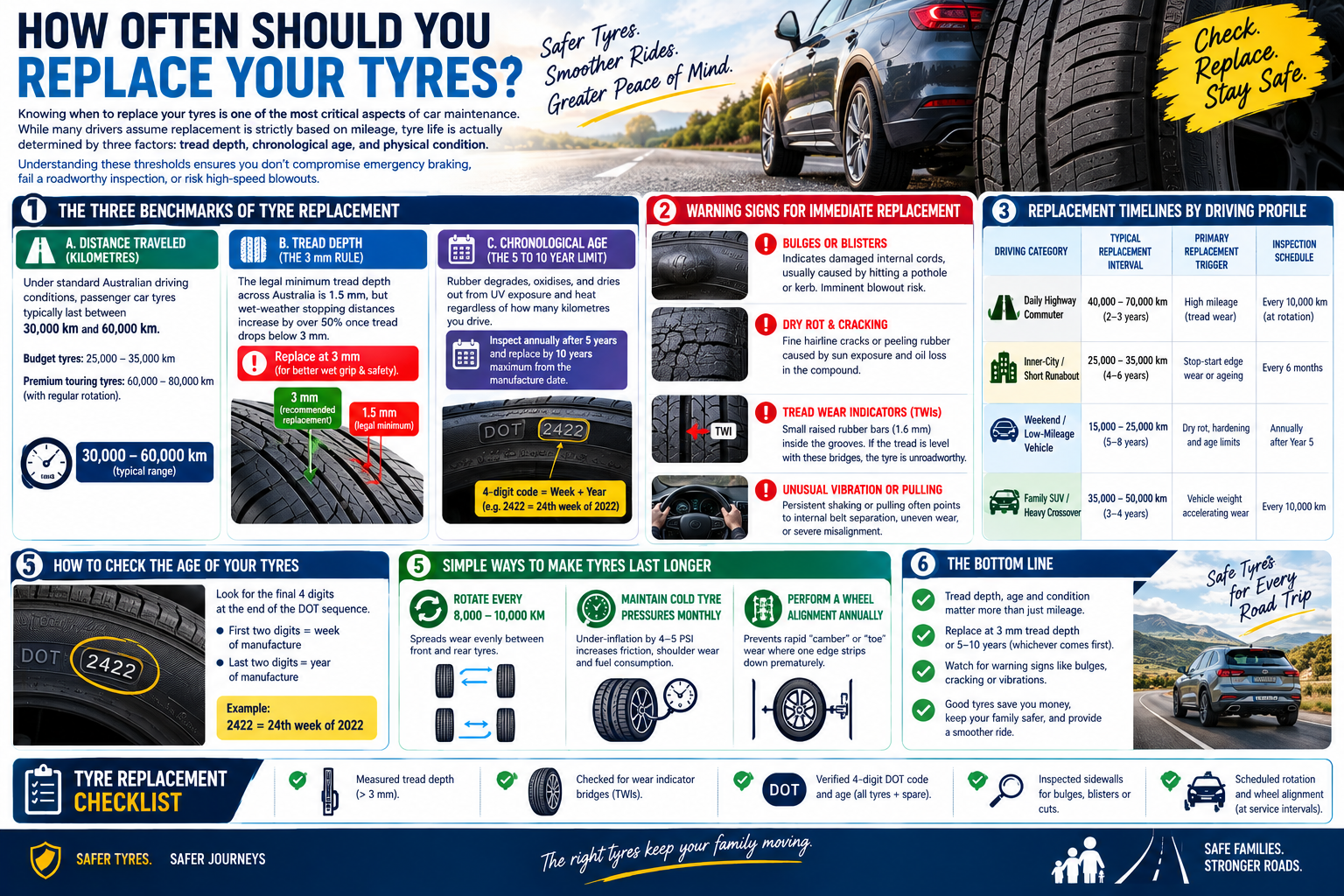
Knowing when to replace your tyres is one of the most critical aspects of car maintenance. While many drivers assume replacement is strictly based on mileage, tyre life is actually determined by three factors: tread depth, chronological age, and physical condition.
Understanding these thresholds ensures you don't compromise emergency braking, fail a roadworthy inspection, or risk high-speed blowouts.
1. The Three Benchmarks of Tyre Replacement
- Distance Traveled (Kilometres): Under standard Australian driving conditions, passenger car tyres typically last between 30,000 km and 60,000 km. Budget tyres tend to wear out near 25,000–35,000 km, while durable premium touring tyres can deliver 60,000–80,000 km when rotated regularly.
- Tread Depth (The 3 mm Rule): The legal minimum tread depth across Australia is 1.5 mm across the central three-quarters of the tread. However, wet-weather stopping distances increase by over 50% once tread drops below 3 mm. Most safety bodies (including the NRMA) advise replacing tyres at the 3 mm mark.
- Chronological Age (The 5-to-10 Year Limit): Rubber degrades, oxidises, and dries out from UV exposure and heat regardless of how many kilometres you drive. Tyres should be professionally inspected annually once they reach 5 years of age and retired by 10 years maximum from their manufacture date, even if they still have plenty of tread.
2. Warning Signs You Need an Immediate Replacement
Kilometres and age aside, replace a tyre immediately if you detect:
- Bulges or Blisters in the Sidewall: Indicates damaged internal cords, usually caused by hitting a pothole or kerb. This represents an imminent blowout risk.
- Dry Rot & Sidewall Cracking (Crazing): Fine hairline cracks or peeling rubber caused by excessive sun exposure and oil loss in the compound.
- Flush Tread Wear Indicators (TWIs): Small raised rubber bars moulded inside the main grooves (sitting at 1.6 mm). If the tread is level with these bridges, the tyre is legally unroadworthy.
- Unusual Vibration or Pulling: Persistent shaking through the steering wheel often points to internal belt separation, heavy uneven wear, or severe misalignment.
Replacement Timelines by Driving Profile
| Driving Category | Typical Replacement Interval | Primary Replacement Trigger | Recommended Inspection Schedule |
|---|---|---|---|
| Daily Highway Commuter | 40,000 – 70,000 km (2–3 years) | Tread wear from high kilometres | Every 10,000 km (at wheel rotation) |
| Inner-City / Short Runabout | 25,000 – 35,000 km (4–6 years) | Stop-start edge wear or rubber ageing | Every 6 months |
| Weekend / Low-Mileage Vehicle | 15,000 – 25,000 km (5–8 years) | Rubber dry rot, hardening, and age limits | Annually after Year 5 |
| Family SUV / Heavy Crossover | 35,000 – 50,000 km (3–4 years) | Vehicle weight accelerating tread wear | Every 10,000 km |
How to Check the Age of Your Tyres
Every modern tyre has a DOT serial code stamped into the outer sidewall. Look for the final 4-digit number at the end of the DOT sequence:
- First two digits: Indicate the week of manufacture.
- Last two digits: Indicate the year of manufacture (e.g., code 2422 means 24th week of 2022).
Simple Ways to Make Tyres Last Longer
- Rotate Every 8,000 to 10,000 km: Spreads mechanical wear evenly between steering front tyres and trailing rear tyres.
- Maintain Cold Tyre Pressures Monthly: Driving on tyres under-inflated by just 4–5 PSI increases friction, shoulder wear, and fuel consumption.
- Perform a Wheel Alignment Annually: Prevents rapid "camber" or "toe" wear where one edge strips down prematurely.
Tyre Replacement Checklist
- Measured tread groove depth with a gauge or coin to ensure it sits safely above 3 mm.
- Verified that tread wear indicator bridges have not met the outer tread surface.
- Checked the 4-digit DOT code on all four tyres and the spare to confirm age.
- Inspected inner and outer sidewalls for bulges, blisters, or deep cuts.
- Scheduled tyre rotation and wheel alignment at your regular service intervals.