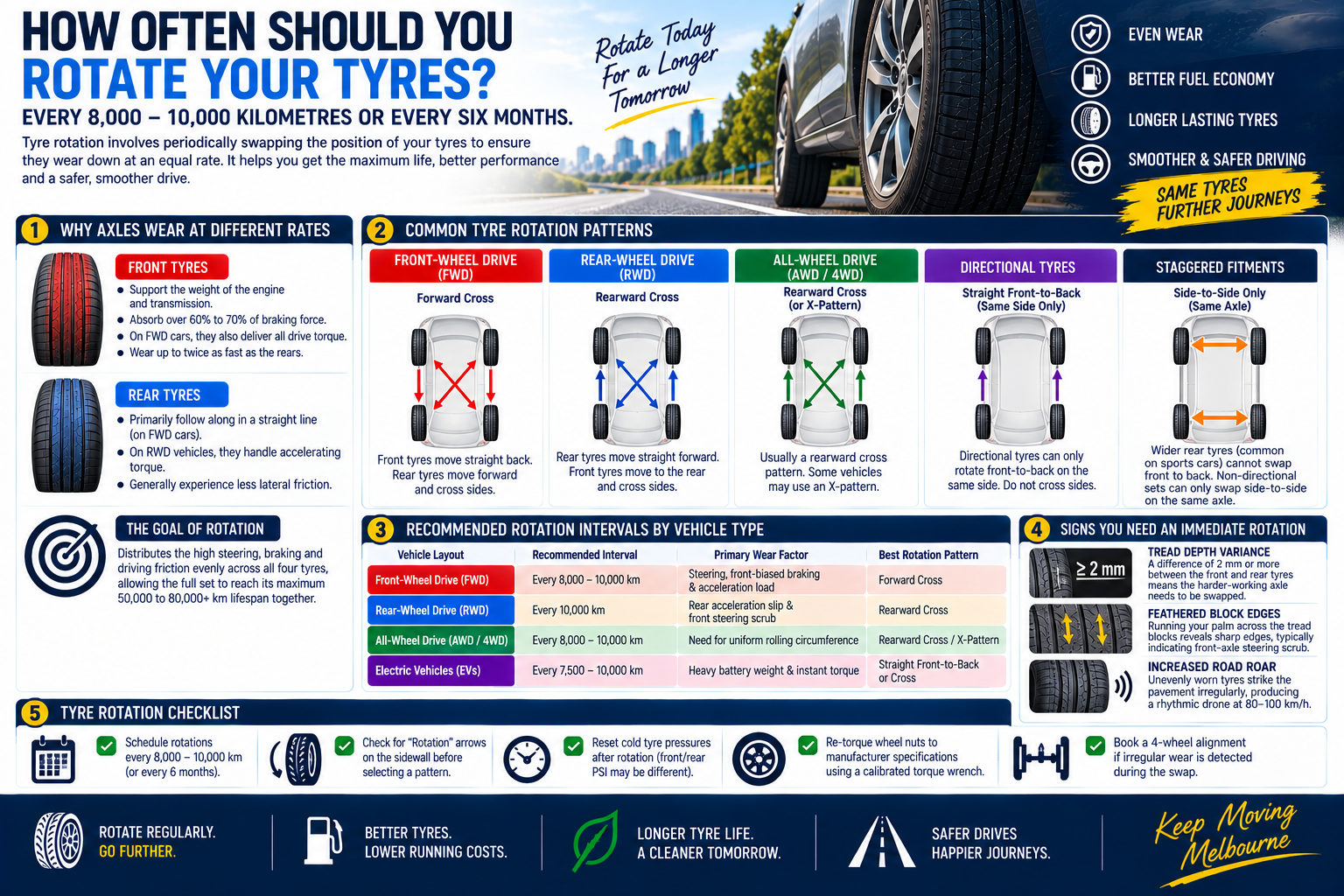
Tyre rotation involves periodically swapping the position of your tyres (front to back or side to side) to ensure they wear down at an equal rate. Because each axle handles different steering, braking, and weight loads, skipping rotations causes premature, uneven tyre wear and shortens the usable lifespan of your set.
As a standard rule of thumb, you should rotate your tyres every 8,000 to 10,000 kilometres or every six months, whichever arrives first.
1. Why Axles Wear at Different Rates
Even on vehicles with perfect wheel alignment, tyres do not experience equal friction:
- Front Tyres: Support the weight of the engine transmission assembly and absorb over 60% to 70% of braking force. On Front-Wheel Drive (FWD) cars, they also deliver all drive torque, scrubbing outer edges during turns and wearing up to twice as fast as the rears.
- Rear Tyres: Primarily follow along in a straight line on FWD cars, experiencing minimal lateral friction. On Rear-Wheel Drive (RWD) vehicles, they bear accelerating torque, causing centre tread wear if pressures are not meticulously kept.
2. Common Tyre Rotation Patterns
The correct rotation pattern depends strictly on your vehicle’s drivetrain layout and whether your tyres have directional tread:
- Front-Wheel Drive (Forward Cross): The front tyres move straight back to the rear axle. The rear tyres move forward and cross sides (Rear Left moves to Front Right; Rear Right moves to Front Left).
- Rear-Wheel Drive & 4WD/AWD (Rearward Cross): The rear tyres move straight forward to the front axle. The front tyres move to the rear axle and cross sides (Front Left moves to Rear Right; Front Right moves to Rear Left).
- Directional Tyres (Straight Front-to-Back): Tyres with a dedicated rolling arrow on the sidewall can only rotate front-to-back on the same side of the vehicle. Crossing sides would cause V-shaped water evacuation channels to run in reverse, creating severe aquaplaning risks.
- Staggered Fitments (Side-to-Side Only): High-performance sports cars with wider wheels on the rear axle cannot swap front to back; non-directional staggered sets can only swap across the same axle.
Recommended Rotation Intervals by Vehicle Type
| Vehicle Layout | Recommended Interval | Primary Wear Factor | Best Rotation Pattern |
|---|---|---|---|
| Front-Wheel Drive (FWD) | Every 8,000 – 10,000 km | Steering, front-biased braking & acceleration load | Forward Cross |
| Rear-Wheel Drive (RWD) | Every 10,000 km | Rear acceleration slip & front steering scrub | Rearward Cross |
| All-Wheel Drive (AWD / 4WD) | Every 8,000 – 10,000 km | Strict need for uniform rolling circumference | Rearward Cross / X-Pattern |
| Electric Vehicles (EVs) | Every 7,500 – 10,000 km | Heavy battery curb weight and instant motor torque | Straight Front-to-Back or Cross |
Signs Your Tyres Need an Immediate Rotation
Do not wait for your scheduled service interval if you notice:
- Tread Depth Variance Across Axles: A difference of 2 mm or more between the front and rear tyres means the harder-working axle needs to be swapped to preserve the set.
- Feathered Block Edges: Running your palm across the tread blocks reveals sharp edges on one side, typically indicating front-axle steering scrub.
- Increased Road Roar: Unevenly worn tyre blocks strike the pavement irregularly, producing a rhythmic drone at 80–100 km/h.
Tyre Rotation Checklist
- Scheduled tyre rotations alongside routine 10,000 km engine oil and filter services.
- Checked the sidewall for "Rotation" directional arrows before selecting a rotation pattern.
- Reset cold tyre pressures after rotation—many cars require different PSI specifications for the front versus rear axles.
- Re-torqued wheel nuts to vehicle manufacturer specifications using a calibrated torque wrench.
- Booked a 4-wheel alignment if irregular inner or outer edge scrub was detected during the swap.