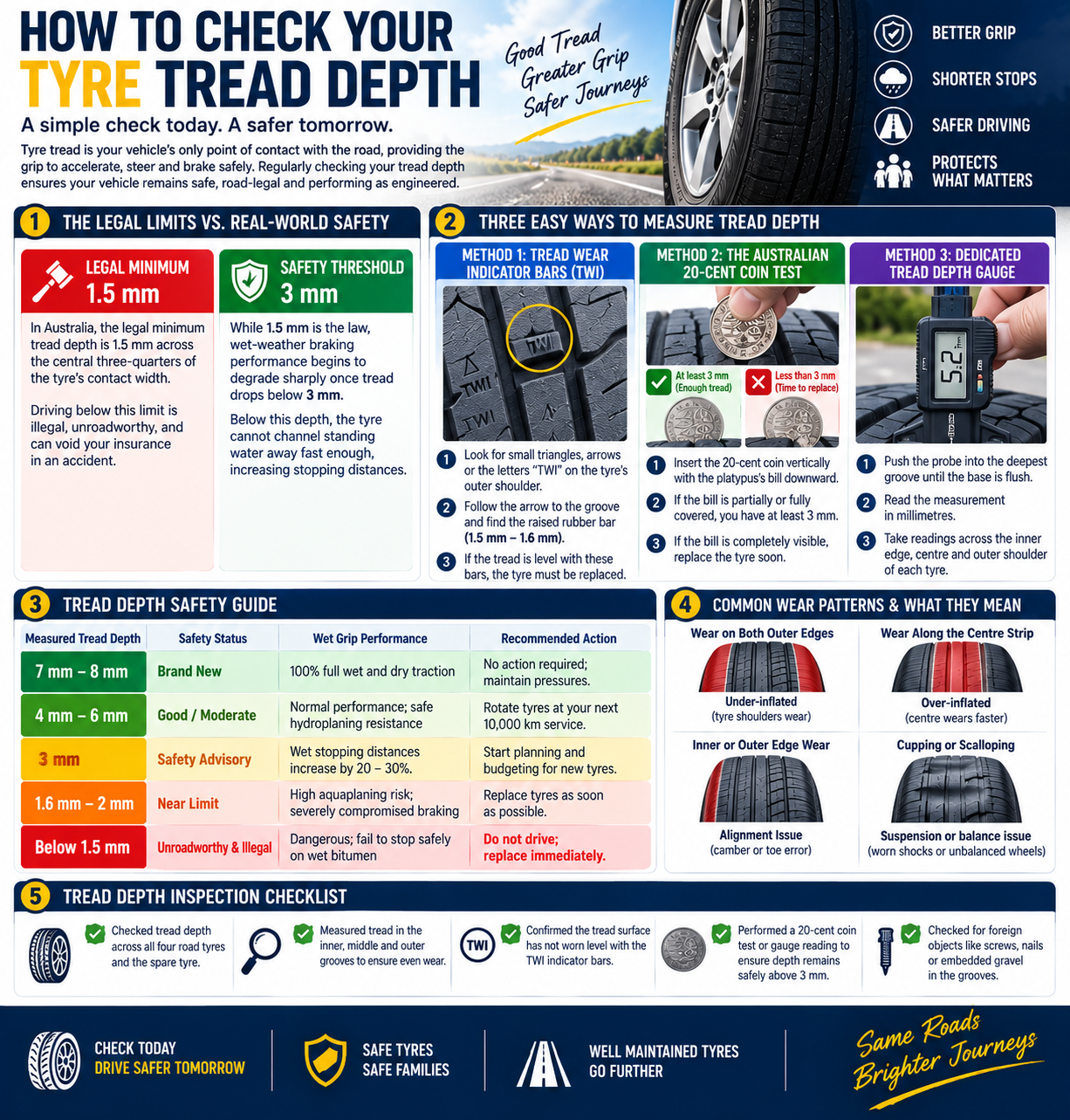
Tyre tread is your vehicle’s only point of contact with the road, providing the necessary grip to accelerate, steer, and brake safely. As tread wears down, your tyres lose their ability to disperse water, dramatically increasing your stopping distance and the risk of aquaplaning in wet conditions.
Regularly checking your tread depth ensures your vehicle remains safe, road-legal, and performing as engineered.
1. The Legal Limits vs. Real-World Safety
- The Legal Minimum (1.5 mm): In Australia, the legal minimum tread depth across all states is 1.5 mm across the central three-quarters of the tyre’s contact width around its entire circumference. Driving below this limit is illegal, unroadworthy, and can void your insurance coverage in an accident.
- The Safety Threshold (3 mm): While 1.5 mm is the law, safety tests demonstrate that wet-weather braking performance begins to degrade sharply once tread drops below 3 mm. Below this depth, the tyre cannot channel standing water away fast enough at highway speeds, significantly increasing stopping distances.
2. Three Easy Ways to Measure Tread Depth
Method 1: Tread Wear Indicator Bars (Built-In)
- Every modern tyre has Tread Wear Indicators (TWIs) built into the main longitudinal grooves. Look for small triangles, arrows, or the letters "TWI" moulded into the tyre’s outer shoulder.
- Follow the arrow inwards to the base of the groove, where you will find raised horizontal rubber bridges sitting 1.5 mm to 1.6 mm tall.
- The Test: If the surrounding tread has worn down level with these raised bars, the tyre has reached its legal limit and must be replaced immediately.
Method 2: The Australian 20-Cent Coin Test
- If you don't have a dedicated measurement tool, an everyday Australian 20-cent piece serves as an effective gauge. Insert the coin vertically into the deepest part of the tyre's main tread grooves, placing the platypus's bill pointing downward into the groove.
- The Result: If the bill is partially or fully covered by the tread, you have at least 3 mm of safe tread depth remaining. If the platypus's bill is completely visible, your tyre is worn below 3 mm and should be scheduled for replacement soon.
Method 3: Dedicated Tyre Tread Depth Gauge (Most Accurate)
- A tyre depth gauge is an inexpensive manual or digital measuring tool available at any auto store. Push the metal probe into the deepest groove until the flat base sits flush against the tyre block surface.
- Read the precise measurement in millimetres. Take readings across the inside edge, centre, and outside shoulder of each tyre to check for uneven alignment wear.
Tread Depth Safety Guide
| Measured Tread Depth | Safety Status | Wet Grip Performance | Recommended Action |
|---|---|---|---|
| 7 mm – 8 mm | Brand New | 100% full wet and dry traction | No action required; maintain pressures. |
| 4 mm – 6 mm | Good / Moderate | Normal performance; safe hydroplaning resistance | Rotate tyres at your next 10,000 km service. |
| 3 mm | Safety Advisory | Wet stopping distances increase by 20–30% | Start planning and budgeting for new tyres. |
| 1.6 mm – 2 mm | Near Limit | High aquaplaning risk; severely compromised wet braking | Replace tyres as soon as possible. |
| Below 1.5 mm | Unroadworthy & Illegal | Dangerous; fail to stop safely on wet bitumen | Do not drive; replace immediately. |
Identifying Irregular Wear During Your Check
When measuring tread depth, never measure only one spot. Wear patterns highlight mechanical and inflation issues:
- Wear on Both Outer Edges: The tyre has been running under-inflated, causing the centre of the contact patch to cave inward.
- Wear Along the Centre Strip Only: The tyre has been over-inflated, focusing the car's weight along the middle band.
- Excessive Wear on the Inside or Outside Edge: Signals a wheel alignment (camber or toe) error or worn suspension bushings.
- Cupping or Scalloping (Dips across the tread): Indicates failing shock absorbers, worn suspension components, or badly unbalanced wheels.
Tread Depth Inspection Checklist
- Checked tread depth across all four road tyres and the spare tyre in the boot.
- Measured tread in the inner, middle, and outer grooves to ensure wear is even.
- Confirmed the tread surface has not worn level with the raised TWI indicator bars.
- Performed a coin test or gauge reading to ensure depth remains safely above 3 mm.
- Checked for foreign objects like screws, nails, or embedded gravel while inspecting the grooves.