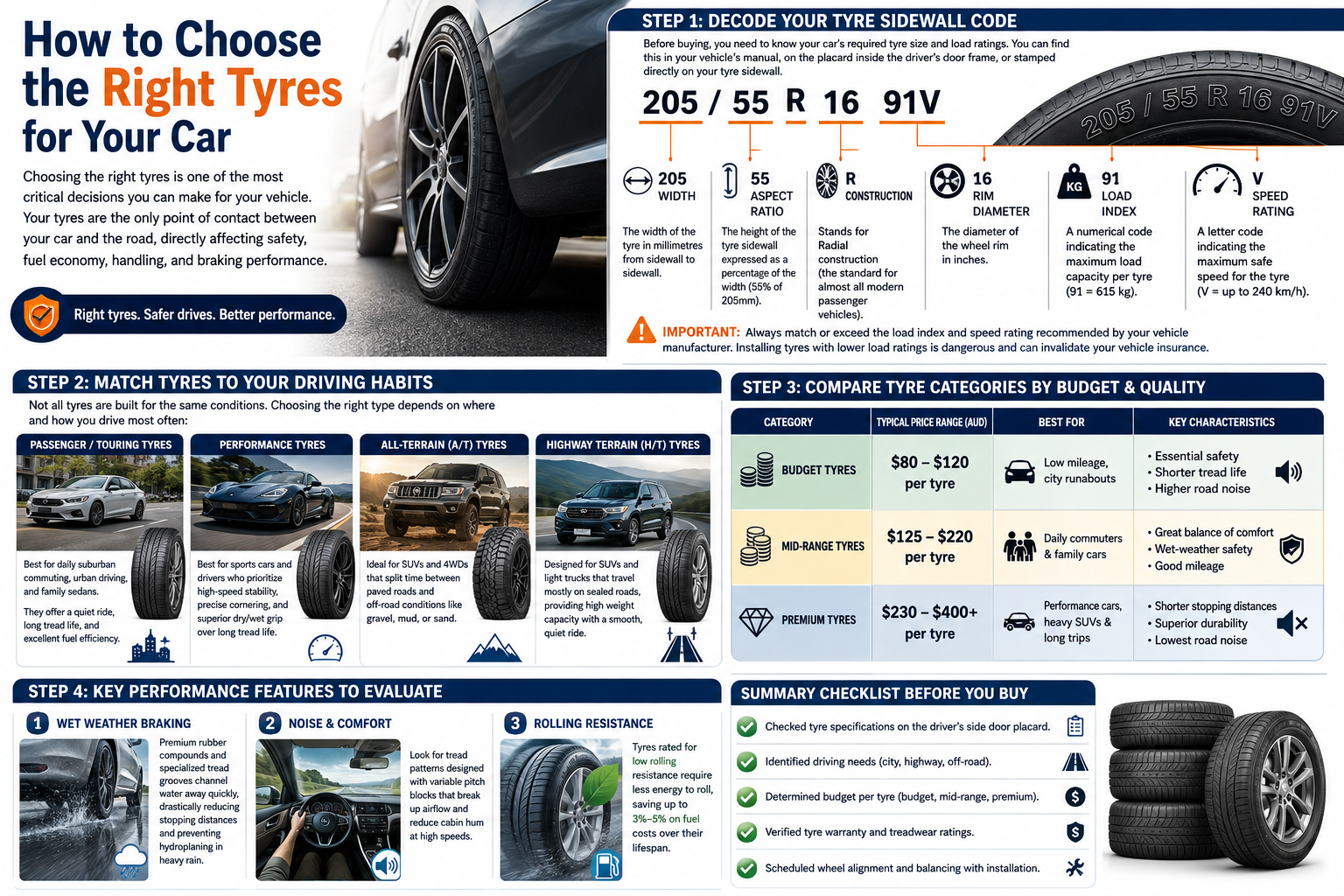
Choosing the right tyres is one of the most critical decisions you can make for your vehicle. Your tyres are the only point of contact between your car and the road, directly affecting safety, fuel economy, handling, and braking performance.
Whether you are navigating daily city commutes, highway driving, or rough back roads around Sunshine, this guide breaks down everything you need to know to make the right choice.
Step 1: Decode Your Tyre Sidewall Code
Before buying, you need to know your car’s required tyre size and load ratings. You can find this in your vehicle’s manual, on the placard inside the driver's door frame, or stamped directly on your current tyre sidewall.
Example Tyre Code: 205 / 55 R 16 91V
- 205 (Width): The width of the tyre in millimetres from sidewall to sidewall.
- 55 (Aspect Ratio): The height of the tyre sidewall expressed as a percentage of the width (55% of 205mm).
- R (Construction): Stands for Radial construction (the standard for almost all modern passenger vehicles).
- 16 (Rim Diameter): The diameter of the wheel rim in inches.
- 91 (Load Index): A numerical code indicating the maximum load capacity per tyre (91 = 615 kg).
- V (Speed Rating): A letter code indicating the maximum safe speed for the tyre (V = up to 240 km/h).
Important: Always match or exceed the load index and speed rating recommended by your vehicle manufacturer. Installing tyres with lower load ratings is dangerous and can invalidate your vehicle insurance.
Step 2: Match Tyres to Your Driving Habits
Not all tyres are built for the same conditions. Choosing the right type depends on where and how you drive most often:
- Passenger / Touring Tyres: Best for daily suburban commuting, urban driving, and family sedans. They offer a quiet ride, long tread life, and excellent fuel efficiency.
- Performance Tyres: Best for sports cars and drivers who prioritize high-speed stability, precise cornering, and superior dry/wet grip over long tread life.
- All-Terrain (A/T) Tyres: Ideal for SUVs and 4WDs that split time between paved roads and off-road conditions like gravel, mud, or sand.
- Highway Terrain (H/T) Tyres: Designed for SUVs and light trucks that travel mostly on sealed roads, providing high weight capacity with a smooth, quiet ride.
Step 3: Compare Tyre Categories by Budget & Quality
| Category | Typical Price Range (AUD) | Best For | Key Characteristics |
|---|---|---|---|
| Budget Tyres | $80 – $120 per tyre | Low mileage, city runabouts | Essential safety, shorter tread life, higher road noise |
| Mid-Range Tyres | $125 – $220 per tyre | Daily commuters & family cars | Great balance of comfort, wet-weather safety, and mileage |
| Premium Tyres | $230 – $400+ per tyre | Performance cars, heavy SUVs & long trips | Shorter stopping distances, superior durability, lowest road noise |
Step 4: Key Performance Features to Evaluate
When comparing specific tyre models, prioritize these three vital characteristics:
- Wet Weather Braking: Premium rubber compounds and specialized tread grooves channel water away quickly, drastically reducing stopping distances and preventing hydroplaning in heavy rain.
- Noise & Comfort: Look for tread patterns designed with variable pitch blocks that break up airflow and reduce cabin hum at high speeds.
- Rolling Resistance: Tyres rated for low rolling resistance require less energy to roll, saving up to 3%–5% on fuel costs over their lifespan.
Summary Checklist Before You Buy
- Checked tyre specifications on the driver’s side door placard.
- Identified driving needs (city, highway, off-road).
- Determined budget per tyre (budget, mid-range, premium).
- Verified tyre warranty and treadwear ratings.
- Scheduled wheel alignment and balancing with installation.