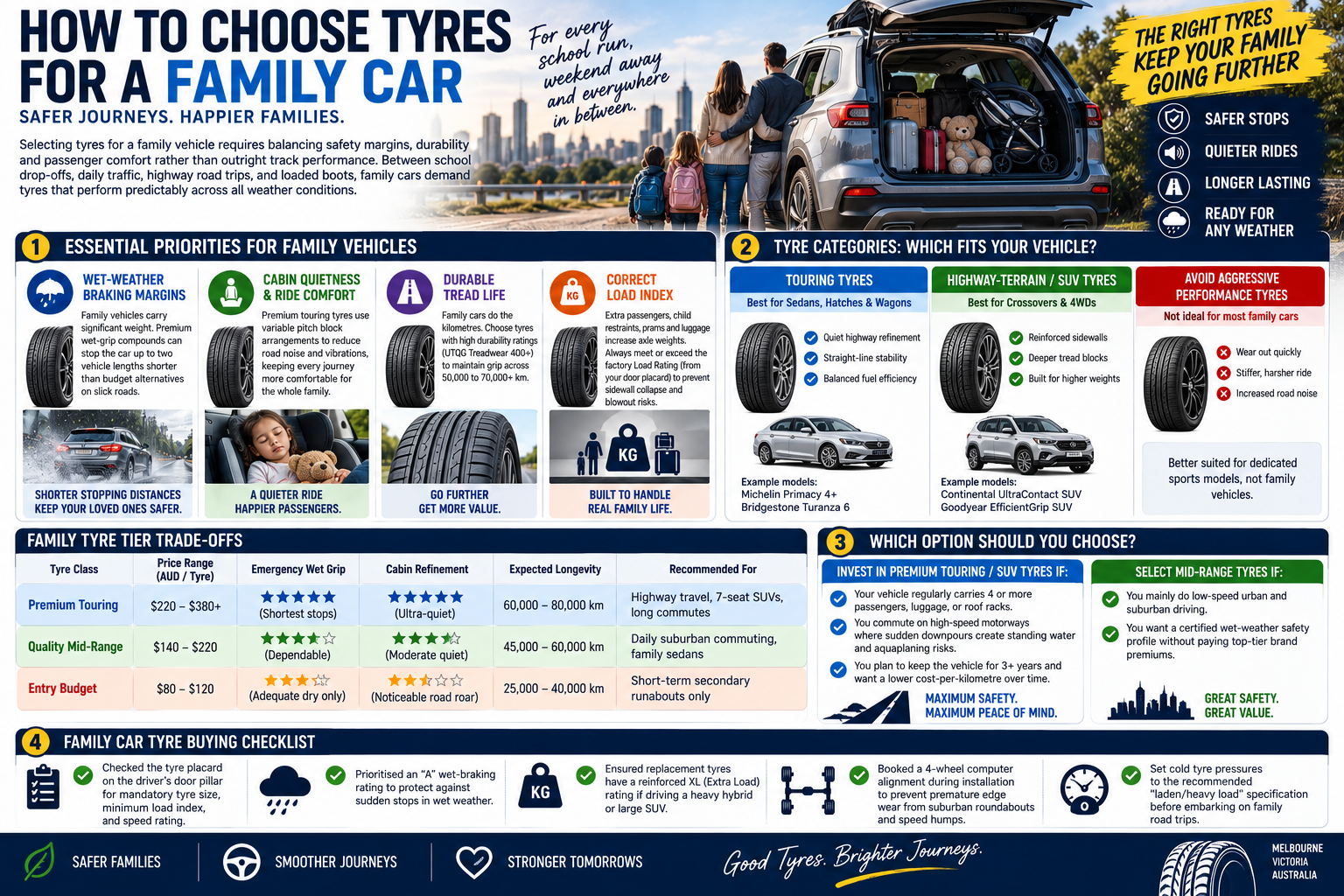
Selecting tyres for a family vehicle requires balancing safety margins, durability, and passenger comfort rather than outright track performance. Between school drop-offs, daily traffic, highway road trips, and loaded boots, family cars demand tyres that perform predictably across all weather conditions.
1. Essential Priorities for Family Vehicles
- Wet-Weather Braking Margins: Family vehicles—especially wagons, mid-size crossovers, and 7-seat SUVs—carry significant payload weight. In emergency braking situations on slick roads, a premium wet-grip compound can stop the car up to two vehicle lengths shorter than entry-level budget alternatives.
- Cabin Quietness & Ride Comfort: Road roar on coarse highway asphalt can cause driver fatigue and disrupt resting passengers. Premium touring tyres use variable pitch block arrangements to cancel out cabin vibrations.
- Durable Tread Life: Family cars accumulate steady mileage from daily school runs, shopping trips, and weekend travel. Tyres with high durability ratings (UTQG Treadwear 400+) provide consistent grip across 50,000 to 70,000+ km.
- Correct Load Index: Extra passenger seats, child restraints, prams, and luggage push axle weights near maximum thresholds. Selecting a tyre that meets or exceeds the factory Load Rating (found on the driver’s door placard) prevents sidewall collapse and blowout risks.
2. Tyre Categories: Which Fits Your Vehicle?
- Touring Tyres (Best for Sedans, Hatches & Wagons): Built for quiet highway refinement, straight-line tracking, and balanced fuel efficiency (e.g., Michelin Primacy 4+, Bridgestone Turanza 6).
- Highway-Terrain / SUV Tyres (Best for Crossovers & 4WDs): Feature reinforced sidewall plies and deeper tread blocks designed to manage higher vehicle centres of gravity and extra curb weights without flex (e.g., Continental UltraContact SUV, Goodyear EfficientGrip SUV).
- Avoid Aggressive Performance Tyres: Unless you drive a dedicated sports model, ultra-high-performance rubber wears down quickly, produces stiffer vertical ride impact, and increases interior tyre roar.
Comparison: Family Tyre Tier Trade-offs
| Tyre Class | Price Range (AUD / Tyre) | Emergency Wet Grip | Cabin Refinement | Expected Longevity | Recommended For |
|---|---|---|---|---|---|
| Premium Touring | $220 – $380+ | ★★★★★ (Shortest stops) | ★★★★★ (Ultra-quiet) | 60,000 – 80,000 km | Highway travel, 7-seat SUVs, long commutes |
| Quality Mid-Range | $140 – $220 | ★★★★☆ (Dependable) | ★★★★☆ (Moderate quiet) | 45,000 – 60,000 km | Daily suburban commuting, family sedans |
| Entry Budget | $80 – $120 | ★★★☆☆ (Adequate dry only) | ★★☆☆☆ (Noticeable road roar) | 25,000 – 40,000 km | Short-term secondary runabouts only |
3. Which Option Should You Choose?
Invest in Premium Touring / SUV Tyres if:
- Your vehicle regularly carries 4 or more passengers, luggage, or roof racks.
- You commute on high-speed motorways where sudden downpours create standing water and aquaplaning risks.
- You plan to keep the vehicle for 3+ years and want a lower cost-per-kilometre over time.
Select Mid-Range Tyres if:
- You mainly do low-speed urban and suburban driving.
- You want a certified wet-weather safety profile without paying top-tier brand premiums.
Family Car Tyre Buying Checklist
- Checked the tyre placard on the driver’s door pillar for mandatory tyre size, minimum load index, and speed rating.
- Prioritised an "A" wet-braking rating to protect against sudden stops in wet weather.
- Ensured replacement tyres have a reinforced XL (Extra Load) rating if driving a heavy hybrid or large SUV.
- Booked a 4-wheel computer alignment during installation to prevent premature edge wear from suburban roundabouts and speed humps.
- Set cold tyre pressures to the recommended "laden/heavy load" specification before embarking on family road trips.