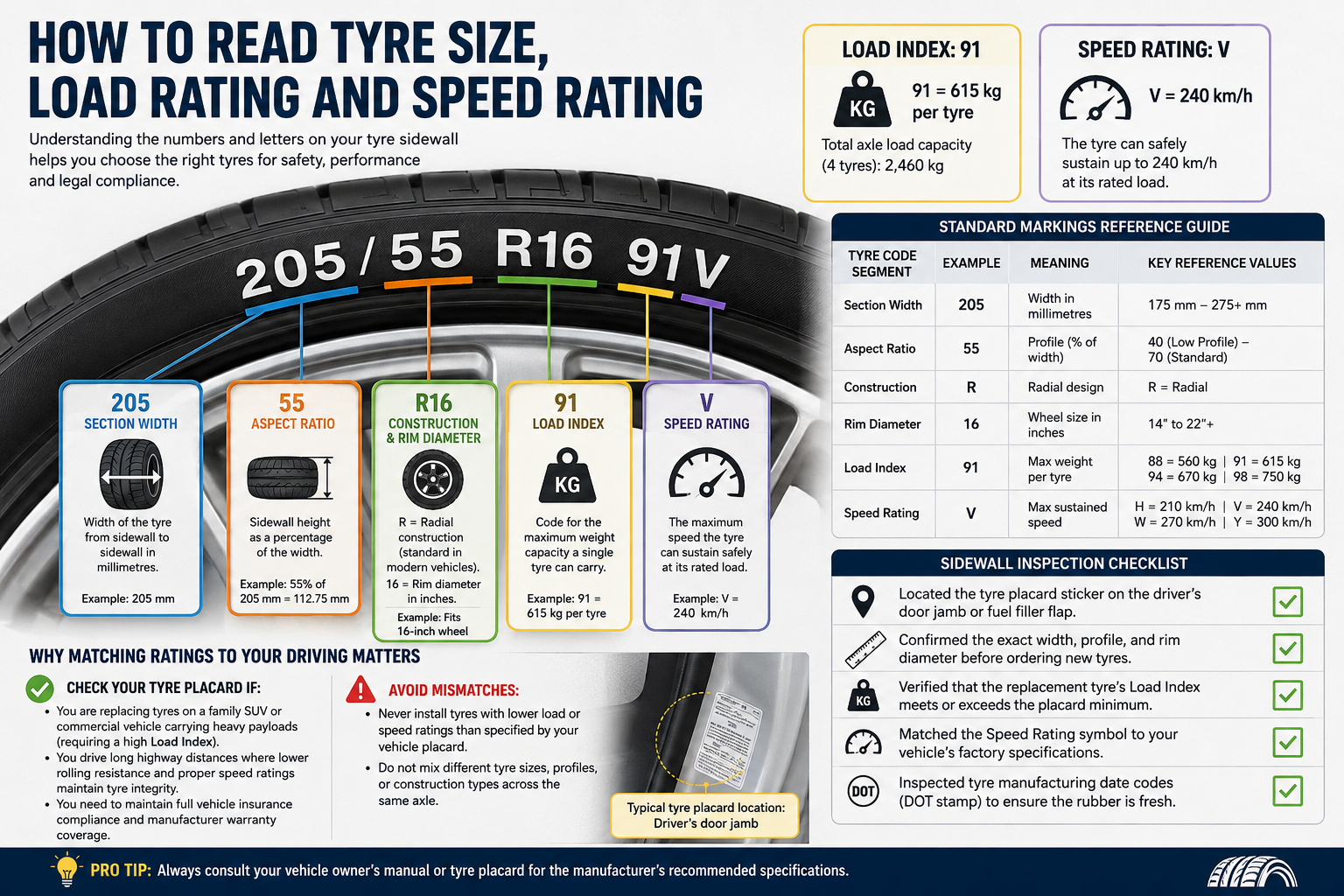
Looking at the sidewall of your tyre, you will notice a complex sequence of letters and numbers such as 205/55 R16 91V. While this code looks technical, each segment represents critical specifications that determine whether a tyre fits your vehicle safely and performs as engineered.
Understanding these markings ensures you purchase the correct replacements, whether choosing budget-friendly options or high-performance premium tyres.
1. Breaking Down Tyre Dimensions: 205/55 R16
The first sequence defines the physical fitment and internal construction of the tyre:
- 205 (Width in mm): The nominal width of the tyre from sidewall to sidewall in millimetres. Wider tyres offer a larger contact patch for grip, while narrower tyres generally improve fuel economy.
- 55 (Aspect Ratio / Profile): The height of the tyre sidewall represented as a percentage of the width. In this example, the sidewall height is 55% of 205 mm (approx. 112.75 mm). Lower profile numbers mean shorter, stiffer sidewalls for sharper steering response.
- R (Internal Construction): Indicates Radial construction, the standard internal layout of ply cords in modern passenger vehicles.
- 16 (Wheel Diameter in Inches): The diameter of the wheel rim that the tyre is engineered to fit.
2. Tyre Load Index: 91
The number following the rim size indicates the Load Index—a numerical code representing the maximum weight capacity a single tyre can safely support at maximum inflation pressure.
- 91: Corresponds to a maximum carrying capacity of 615 kg per tyre (or 2,460 kg total axle load across all four wheels).
Legal & Safety Rule: You must never fit a tyre with a load index lower than the vehicle manufacturer's minimum recommendation (found on your tyre placard inside the driver's door frame).
3. Tyre Speed Rating: V
The final letter indicates the Speed Rating—the maximum speed the tyre can sustain safely under its rated load capacity over an extended period.
- V: Rated for speeds up to 240 km/h.
- Heat Dissipation: Speed ratings reflect the tyre's ability to resist and dissipate heat buildup at sustained speeds.
Standard Markings Reference Guide
| Tyre Code Segment | Example | Meaning | Key Reference Values |
|---|---|---|---|
| Section Width | 205 | Width in millimetres | 175 mm – 275+ mm |
| Aspect Ratio | 55 | Profile (% of width) | 40 (Low Profile) – 70 (Standard) |
| Construction | R | Radial design | R = Radial |
| Rim Diameter | 16 | Wheel size in inches | 14" to 22"+ |
| Load Index | 91 | Max weight per tyre | 88 = 560 kg | 91 = 615 kg | 94 = 670 kg | 98 = 750 kg |
| Speed Rating | V | Max sustained speed | H = 210 km/h | V = 240 km/h | W = 270 km/h | Y = 300 km/h |
Why Matching Ratings to Your Driving Matters
Check Your Tyre Placard if:
- You are replacing tyres on a family SUV or commercial vehicle carrying heavy payloads (requiring a high Load Index).
- You drive long highway distances where lower rolling resistance and proper speed ratings maintain tyre integrity.
- You need to maintain full vehicle insurance compliance and manufacturer warranty coverage.
Avoid Mismatches:
- Never install tyres with lower load or speed ratings than specified by your vehicle placard.
- Do not mix different tyre sizes, profiles, or construction types across the same axle.
Sidewall Inspection Checklist
- Located the tyre placard sticker on the driver’s door jamb or fuel filler flap.
- Confirmed the exact width, profile, and rim diameter before ordering new tyres.
- Verified that the replacement tyre's Load Index meets or exceeds the placard minimum.
- Matched the Speed Rating symbol to your vehicle's factory specifications.
- Inspected tyre manufacturing date codes (DOT stamp) to ensure the rubber is fresh.