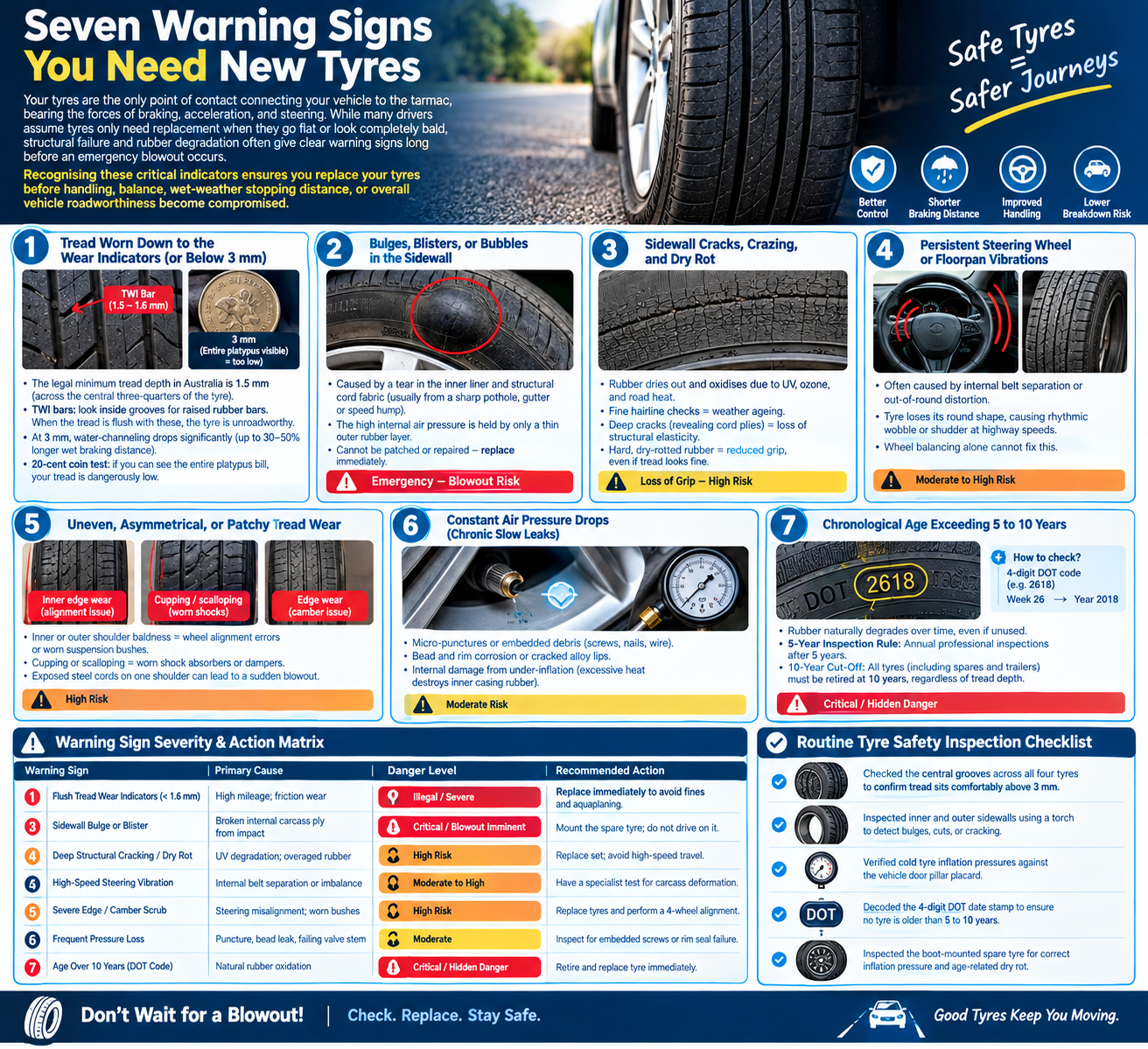
Your tyres are the only point of contact connecting your vehicle to the tarmac, bearing the forces of braking, acceleration, and steering. While many drivers assume tyres only need replacement when they go flat or look completely bald, structural failure and rubber degradation often give clear warning signs long before an emergency blowout occurs.
Recognising these critical indicators ensures you replace your tyres before handling balance, wet-weather stopping distance, or overall vehicle roadworthiness become compromised.
1. Tread Worn Down to the Wear Indicators (or Below 3 mm)
The legal minimum tread depth across Australia is 1.5 mm across the central three-quarters of the tyre. However, waiting until the legal limit significantly compromises safety:
- Tread Wear Indicator (TWI) Bars: Look inside the main circumferential grooves for raised rubber bars (set at 1.5 mm to 1.6 mm). When the outer tread pattern wears completely flush with these bridges, the tyre is legally unroadworthy.
- The Wet-Grip Drop-Off: At 3 mm, tyres already lose substantial water-channeling capability, increasing wet-braking distances by up to 30% to 50%. If an Australian 20-cent coin inserted into the grooves reveals the entire platypus bill, your tread is dangerously low.
2. Bulges, Blisters, or Bubbles in the Sidewall
A visible lump or bubble protruding from the tyre sidewall is an emergency:
- Internal Structural Damage: Sidewall bubbles occur when the inner airtight liner and structural cord fabric tear—usually after striking a sharp pothole, gutter, or speed hump.
- Imminent Blowout Risk: The tyre's high internal air pressure is held in by only a thin outer layer of flexible rubber. This cannot be patched or repaired; the tyre must be replaced immediately.
3. Sidewall Cracks, Crazing, and Dry Rot
Rubber is an organic compound that dries out and oxidises when exposed to atmospheric ozone, UV radiation, and road heat:
- Spiderweb Crazing vs. Deep Fissures: Fine hairline surface checks indicate weather ageing, but deep cracks extending into the carcass or revealing internal cord plies mean the rubber compound has hardened and lost structural elasticity.
- Loss of Grip: Hard, dry-rotted rubber acts like slick plastic against damp tarmac, severely degrading braking traction even if tread depth appears intact.
4. Persistent Steering Wheel or Floorpan Vibrations
While minor vibrations often stem from simple wheel balancing issues or alignment errors, persistent shaking can indicate internal tyre failure:
- Belt Separation: If the internal steel belts beneath the tread begin to delaminate or shift due to age or impact damage, the tyre loses its round shape.
- Out-of-Round Distortion: This structural deformity causes a rhythmic wobble or shudder through the steering wheel at highway speeds that dynamic wheel balancing cannot resolve.
5. Uneven, Asymmetrical, or Patchy Tread Wear
Tread should wear evenly across the entire contact width. Patchy or lopsided wear signals underlying mechanical issues:
- Inner or Outer Shoulder Baldness: Points to severe wheel alignment errors (camber or toe misalignment) or worn suspension control arm bushes dragging the tyre sideways.
- Cupping or Scalloping (Dips Along the Tread): Indicates worn-out shock absorbers or suspension dampers allowing the wheel to bounce irregularly along the pavement. Once steel cords are exposed on one shoulder, the tyre can blow out unexpectedly.
6. Constant Air Pressure Drops (Chronic Slow Leaks)
If you find yourself reinflating the same tyre every few days or weeks, the tyre assembly has an unaddressed fault:
- Micro-Punctures & Embedded Debris: Small screws, nails, or wire shards lodged in the rubber can leak slowly over weeks.
- Bead and Rim Corrosion: Rim corrosion or cracked alloy lips break the airtight seal between the tyre bead and the wheel rim.
- Internal Damage: Continually driving on an under-inflated tyre generates excessive sidewall heat, destroying the inner casing rubber and turning it into loose rubber powder inside.
7. Chronological Age Exceeding 5 to 10 Years
Even if a tyre has sat unused in a dark garage or the vehicle has covered low mileage, rubber naturally degrades over time:
- The 5-Year Inspection Rule: Once a tyre reaches 5 years from its date of manufacture, it must receive annual professional inspections for internal decay and hardening.
- The 10-Year Cut-Off: Tyre manufacturers and road safety bodies mandate that all tyres—including boot-mounted spare tyres and trailer rubber—must be retired at 10 years of age, regardless of how much tread remains. Inspect the 4-digit DOT code on the sidewall (e.g., 2618 indicates the 26th week of 2018).
Warning Sign Severity & Action Matrix
| Warning Sign | Primary Cause | Danger Level | Recommended Action |
|---|---|---|---|
| Flush Tread Wear Indicators (< 1.6 mm) | High mileage; friction wear | Illegal / Severe | Replace immediately to avoid fines and aquaplaning. |
| Sidewall Bulge or Blister | Broken internal carcass ply from impact | Critical / Blowout Imminent | Mount the spare tyre; do not drive on it. |
| Deep Structural Cracking / Dry Rot | UV degradation; overaged rubber | High Risk | Replace set; avoid high-speed freeway travel. |
| High-Speed Steering Vibration | Internal belt separation or imbalance | Moderate to High | Have a tyre specialist test for carcass deformation. |
| Severe Edge / Camber Scrub | Steering misalignment; worn bushes | High Risk | Replace worn tyres and perform a 4-wheel alignment. |
| Frequent Pressure Loss | Puncture, bead leak, or failing valve stem | Moderate | Inspect for embedded screws or rim seal failure. |
| Age Over 10 Years (DOT Code) | Natural rubber oxidation | Critical / Hidden Danger | Retire and replace tyre immediately. |
Routine Tyre Safety Inspection Checklist
- Checked the central grooves across all four tyres to confirm tread sits comfortably above 3 mm.
- Inspected inner and outer sidewalls using a torch to detect bulges, cuts, or cracking.
- Verified cold tyre inflation pressures against the vehicle door pillar placard.
- Decoded the 4-digit DOT date stamp to ensure no tyre is older than 5 to 10 years.
- Inspected the boot-mounted spare tyre for correct inflation pressure and age-related dry rot.