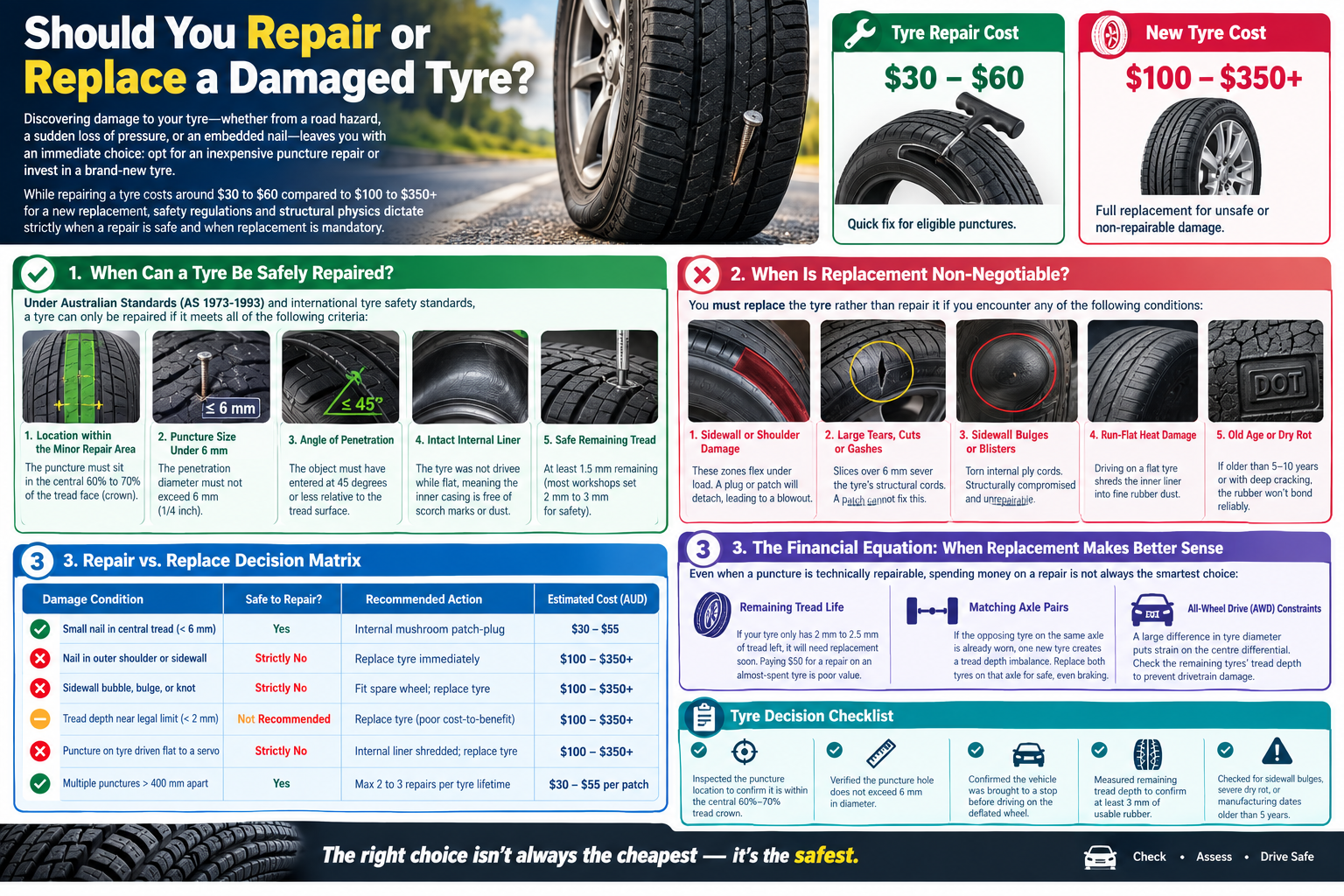
Discovering damage to your tyre—whether from a road hazard, a sudden loss of pressure, or an embedded nail—leaves you with an immediate choice: opt for an inexpensive puncture repair or invest in a brand-new tyre.
While repairing a tyre costs around $30 to $60 compared to $100 to $350+ for a new replacement, safety regulations and structural physics dictate strictly when a repair is safe and when replacement is mandatory.
1. When Can a Tyre Be Safely Repaired?
Under Australian Standards (AS 1973-1993) and international tyre safety standards, a tyre can only be repaired if it meets all of the following criteria:
- Location within the Minor Repair Area: The puncture must sit strictly within the central 60% to 70% of the tread face (the crown), which contains rigid high-tensile steel belts capable of anchoring an internal patch-plug assembly.
- Puncture Size Under 6 mm: The penetration diameter caused by a nail, screw, or wire must not exceed 6 mm (1/4 inch).
- Angle of Penetration: The puncturing object must have entered at an angle of 45 degrees or less relative to the tread surface.
- Intact Internal Liner: The tyre was not driven while flat, meaning the inner casing is free of friction scorch marks or pulverised black rubber dust.
- Safe Remaining Tread: The tyre must have at least 1.5 mm of tread depth remaining across the entire circumference (with most workshops setting a minimum threshold of 2 mm to 3 mm for safety).
2. When Is Replacement Non-Negotiable?
You must replace the tyre rather than repair it if you encounter any of the following conditions:
- Sidewall or Shoulder Damage: The sidewall and outer tread shoulders flex continuously under vehicle weight and cornering loads; patches applied here will detach, leading to an imminent high-speed blowout.
- Large Tears, Cuts, or Gashes: Slices from sharp metal or glass exceeding 6 mm sever structural cords that patches cannot bridge.
- Sidewall Bulges or Blisters: Bubbles indicate torn internal ply cords from hitting a curb or pothole, making the structure unrepairable.
- Run-Flat Internal Heat Damage: Driving on an uninflated tyre crushes and grinds the inner liner into fine rubber shavings.
- Old Age or Severe Dry Rot: Tyres older than 5 to 10 years or showing deep weather cracking will not bond reliably with vulcanising cement.
Repair vs. Replace Decision Matrix
| Damage Condition | Safe to Repair? | Recommended Action | Estimated Cost (AUD) |
|---|---|---|---|
| Small nail in central tread (< 6 mm) | Yes | Internal combination mushroom patch-plug | $30 – $55 |
| Nail in outer shoulder or sidewall | Strictly No | Replace tyre immediately | $100 – $350+ |
| Sidewall bubble, bulge, or knot | Strictly No | Fit spare wheel; replace tyre | $100 – $350+ |
| Tread depth near legal limit (< 2 mm) | Not Recommended | Replace tyre (poor cost-to-benefit ratio) | $100 – $350+ |
| Puncture on tyre driven flat to a servo | Strictly No | Internal liner shredded; replace tyre | $100 – $350+ |
| Multiple punctures > 400 mm apart | Yes | Maximum 2 to 3 repairs per tyre lifetime | $30 – $55 per patch |
3. The Financial Equation: When Replacement Makes Better Sense
Even when a puncture is technically repairable, spending money on a repair is not always the smartest financial choice if remaining tread depth is near the limit (2 mm to 2.5 mm), matching axle pairs require balanced wear, or All-Wheel Drive (AWD) constraints mandate uniform tyre diameters to protect centre differentials.
Tyre Decision Checklist
- Inspected the puncture location to confirm it is within the central 60%–70% tread crown.
- Verified that the puncture hole does not exceed 6 mm in diameter.
- Confirmed the vehicle was brought to a stop before driving on the deflated wheel.
- Measured remaining tread depth to confirm the tyre has at least 3 mm of usable rubber.
- Checked for sidewall bulges, severe dry rot, or manufacturing dates older than 5 years.