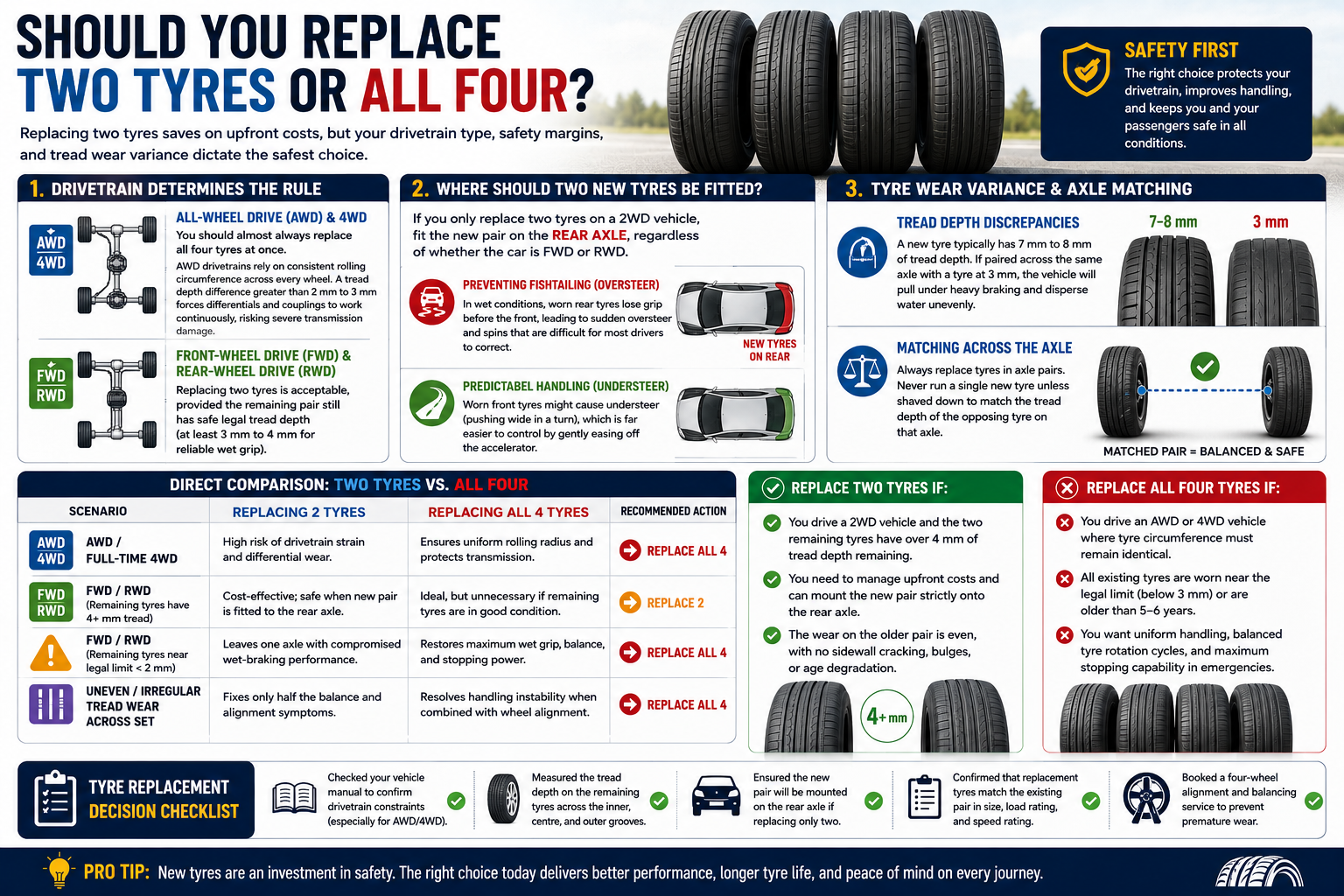
When tyre wear sets in or an unrepairable puncture occurs, deciding whether to replace just two tyres or invest in a complete set of four is a common dilemma. Replacing two tyres saves on upfront costs, but your drivetrain type, safety margins, and tread wear variance dictate the safest choice.
Understanding when a partial replacement is acceptable versus when a full set is essential ensures your vehicle remains balanced, safe, and mechanically sound.
1. Drivetrain Determines the Rule
Your car's drive layout is the most critical factor when deciding between replacing two or all four tyres:
- All-Wheel Drive (AWD) & 4WD: You should almost always replace all four tyres at once. AWD drivetrains rely on consistent rolling circumference across every wheel. A tread depth difference greater than 2 mm to 3 mm forces centre differentials and viscous couplings to work continuously, risking severe transmission damage.
- Front-Wheel Drive (FWD) & Rear-Wheel Drive (RWD): Replacing two tyres is acceptable, provided the remaining pair still possesses safe legal tread depth (at least 3 mm to 4 mm for reliable wet grip).
2. Where Should Two New Tyres Be Fitted?
If you only replace two tyres on a 2WD vehicle, fit the new pair on the rear axle, regardless of whether the car is Front-Wheel Drive or Rear-Wheel Drive:
- Preventing Fishtailing (Oversteer): In wet conditions, worn rear tyres lose grip before the front, leading to sudden oversteer and spins that are difficult for most drivers to correct.
- Predictable Handling (Understeer): Worn front tyres might cause understeer (pushing wide in a turn), which is far easier to control by gently easing off the accelerator.
3. Tyre Wear Variance & Axle Matching
A single new tyre or an uneven pair alters vehicle dynamics under emergency braking:
- Tread Depth Discrepancies: A new tyre typically has 7 mm to 8 mm of tread depth. If paired across the same axle with a tyre at 3 mm, the vehicle will pull under heavy braking and disperse water unevenly.
- Matching Across the Axle: Always replace tyres in axle pairs. Never run a single new tyre unless shaved down to match the tread depth of the opposing tyre on that axle.
Direct Comparison: Two Tyres vs. All Four
| Scenario | Replacing 2 Tyres | Replacing All 4 Tyres | Recommended Action |
|---|---|---|---|
| AWD / Full-Time 4WD | High risk of drivetrain strain and differential wear | Ensures uniform rolling radius and protects transmission | Replace all 4 |
| FWD / RWD (Remaining tyres have 4+ mm tread) | Cost-effective; safe when new pair is fitted to the rear axle | Ideal, but unnecessary if remaining tyres are in good condition | Replace 2 |
| FWD / RWD (Remaining tyres near legal limit < 2 mm) | Leaves one axle with compromised wet-braking performance | Restores maximum wet grip, balance, and stopping power | Replace all 4 |
| Uneven / Irregular Tread Wear Across Set | Fixes only half the balance and alignment symptoms | Resolves handling instability when combined with wheel alignment | Replace all 4 |
Which Option Should You Choose?
Replace Two Tyres if:
- You drive a 2WD vehicle and the two remaining tyres have over 4 mm of tread depth remaining.
- You need to manage upfront costs and can mount the new pair strictly onto the rear axle.
- The wear on the older pair is even, with no sidewall cracking, bulges, or age degradation.
Replace All Four Tyres if:
- You drive an AWD or 4WD vehicle where tyre circumference must remain identical.
- All existing tyres are worn near the legal limit (below 3 mm) or are older than 5–6 years.
- You want uniform handling, balanced tyre rotation cycles, and maximum stopping capability in emergency situations.
Replacement Decision Checklist
- Checked your vehicle manual to confirm drivetrain constraints (especially for AWD/4WD).
- Measured the tread depth on the remaining tyres across the inner, centre, and outer grooves.
- Ensured the new pair will be mounted on the rear axle if replacing only two.
- Confirmed that replacement tyres match the existing pair in size, load rating, and speed rating.
- Booked a four-wheel alignment and balancing service to prevent premature wear on new rubber.