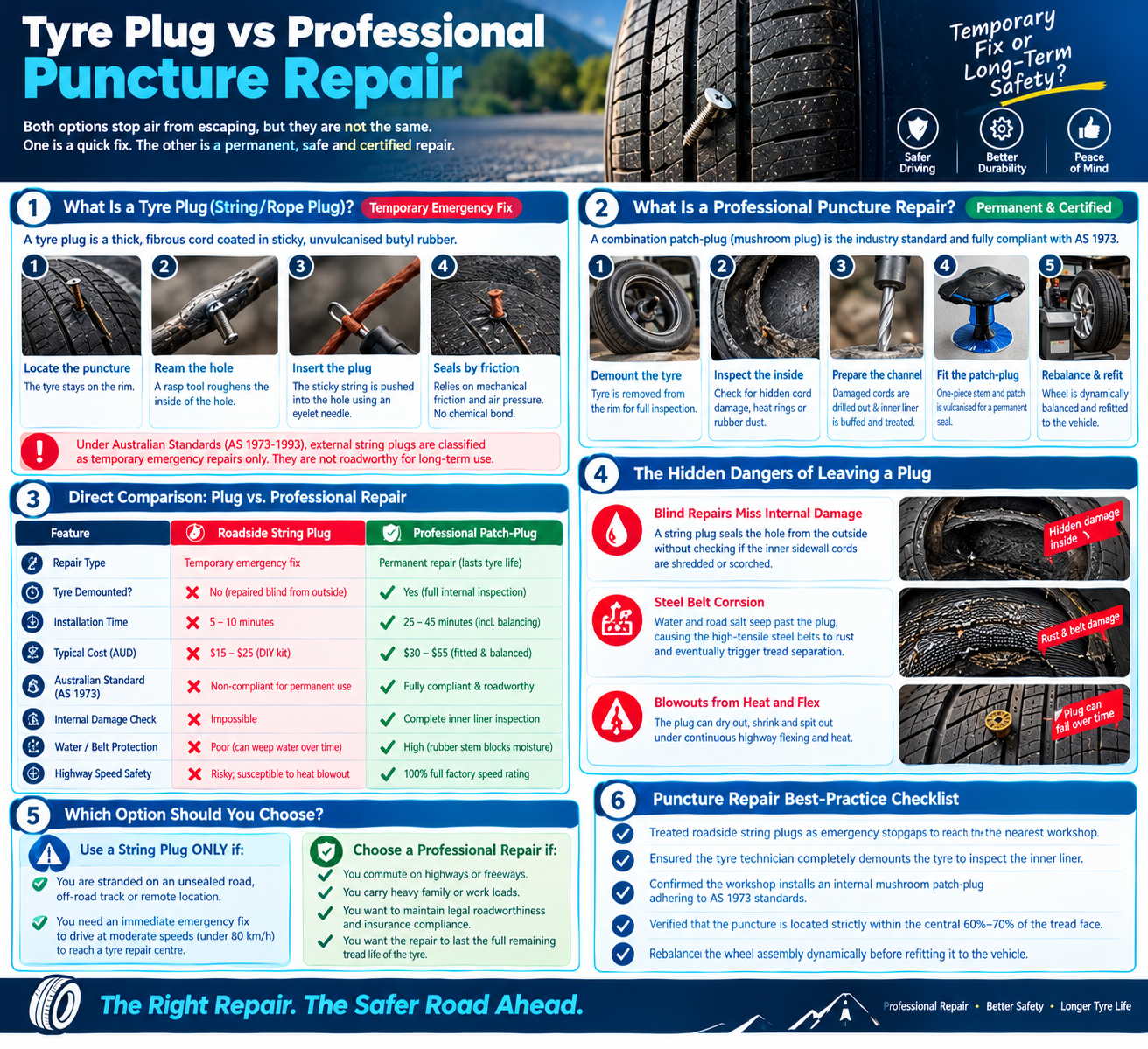
When dealing with a nail or screw in your tyre, you will generally encounter two repair options: an inexpensive roadside tyre plug inserted from the outside in minutes, or a professional puncture repair conducted inside a workshop.
While both methods stop air from escaping, they are fundamentally different in structural durability, legal roadworthiness, and driving safety.
1. What Is a Tyre Plug (String/Rope Plug)?
A tyre plug is a thick, fibrous cord coated in sticky, unvulcanised butyl rubber:
- The Process: The tyre remains mounted on the wheel rim. A technician or driver uses a metal rasp tool to ream the puncture hole, threads the sticky string through an eyelet needle, and forces it directly into the hole from the outside.
- How It Seals: The plug physically jams into the hole, relying on mechanical friction and internal air pressure to hold it in place without forming any chemical or vulcanised bond with the tyre rubber.
- The Legal Reality: Under Australian Standards (AS 1973-1993), external string plugs are classified as temporary emergency repairs designed strictly to get you off a dangerous roadside or remote track to the nearest repair centre.
2. What Is a Professional Puncture Repair (Combination Patch-Plug)?
A professional repair—often referred to as a mushroom plug or two-piece combination repair—is the industry standard recognised by major tyre manufacturers, VicRoads, and international safety bodies (USTMA/TIA):
- The Process: The wheel is removed from the car and the tyre is completely demounted from the rim.
- Internal Casing Inspection: The technician checks the inner liner for hidden cord damage, heat scorch rings, or pulverised rubber dust caused by driving while flat.
- Channel Preparation & Vulcanisation: Damaged steel cords are drilled out cleanly with a carbide bit, the inner liner is buffed smooth, treated with chemical vulcanising fluid, and fitted with a single-piece patch-and-stem unit.
- Dual-Action Seal: The integrated rubber stem seals the drilled channel from the inside out to block water from rusting the internal steel belts, while the flat patch permanently bonds to the airtight inner liner.
Direct Comparison: Plug vs. Professional Repair
| Feature | Roadside String Plug | Professional Combination Patch-Plug |
|---|---|---|
| Repair Type | Temporary emergency fix | Permanent repair (lasts tyre lifespan) |
| Tyre Demounted? | No (repaired blind from outside) | Yes (full internal inspection) |
| Installation Time | 5 – 10 minutes | 25 – 45 minutes (incl. balancing) |
| Typical Cost (AUD) | $15 – $25 (DIY kit) | $30 – $55 (fitted & balanced) |
| Australian Standard (AS 1973) | Non-compliant for permanent use | Fully compliant & roadworthy |
| Internal Damage Check | Impossible | Complete inner liner inspection |
| Water / Belt Protection | Poor (can weep water over time) | High (rubber stem blocks moisture) |
| Highway Speed Safety | Risky; susceptible to heat blowout | 100% full factory speed rating |
3. The Hidden Dangers of Leaving a Plug In Long-Term
Treating a $20 roadside string plug as a permanent fix carries genuine risks, including blind repairs missing internal flat-driving damage, rainwater seeping past the plug to rust steel belts, and the rubber compound shrinking and spitting out under continuous highway heat and flexing.
Which Option Should You Choose?
Use a String Plug ONLY if:
- You are stranded on an unsealed regional road, off-road 4WD track, or remote location with no mobile reception.
- You need an immediate emergency fix to drive at moderate speeds (under 80 km/h) to reach a tyre repair centre.
Always Choose a Professional Puncture Repair if:
- You commute on highways, freeways, or carry heavy family and work loads.
- You want to maintain the full legal roadworthiness and insurance compliance of your vehicle.
- You want the repair to last the full remaining tread life of the tyre.
Puncture Repair Best-Practice Checklist
- Treated roadside string plugs as emergency stopgaps to reach the nearest tyre workshop.
- Ensured the tyre technician completely dismounts the tyre to inspect the inner liner.
- Confirmed the workshop installs an internal mushroom patch-plug adhering to AS 1973 standards.
- Verified that the puncture is located strictly within the central 60%–70% of the tread face.
- Rebalanced the wheel assembly dynamically before bolting it back onto the vehicle.