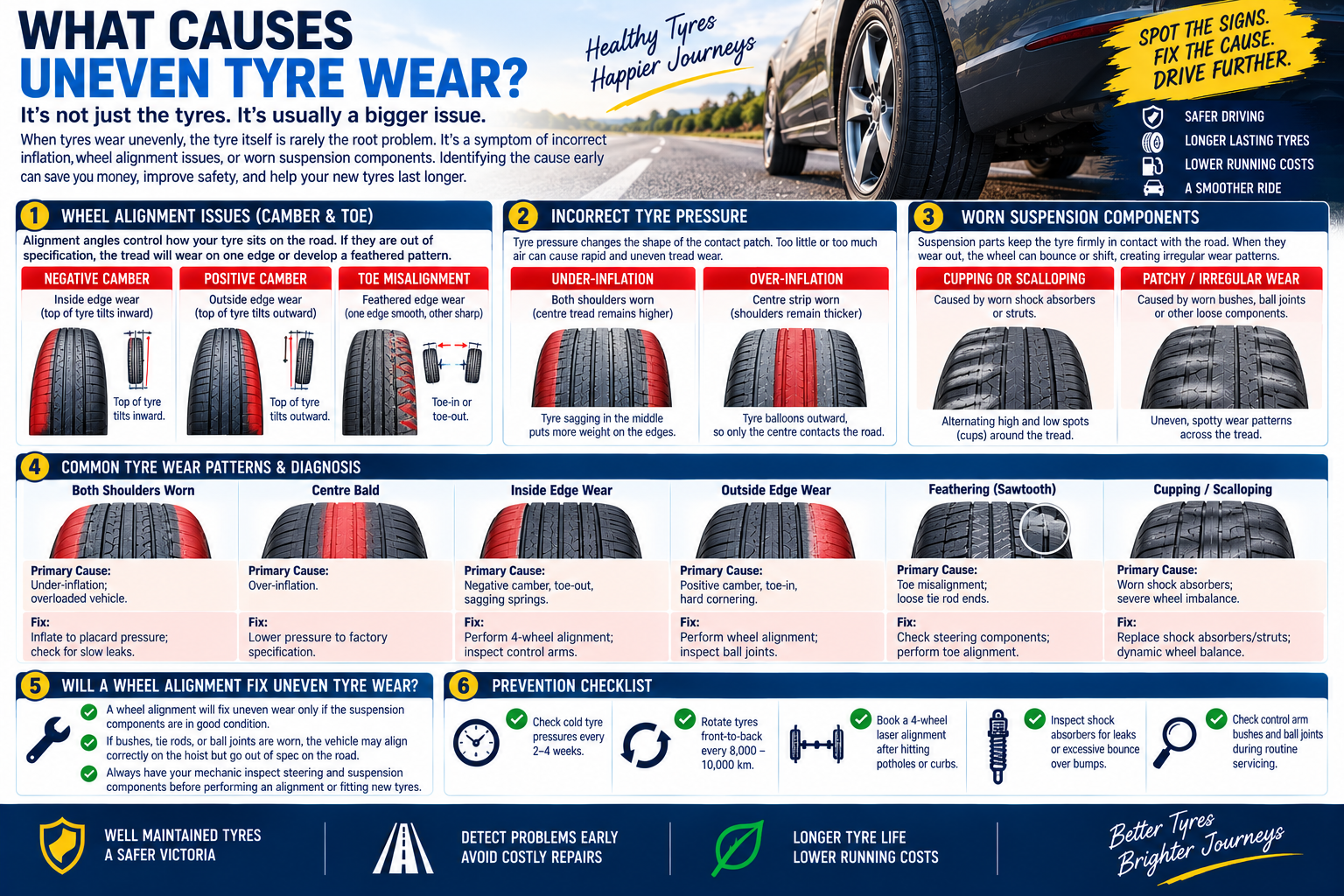
When tyres wear down unevenly, the tyre itself is rarely the root problem. Uneven wear is typically a symptom of incorrect inflation pressures, misaligned steering geometry, or worn suspension components.
Because the tread wear pattern reveals exactly how mechanical forces are misdirected against the road, inspecting your tyres can help diagnose underlying vehicle issues before they cause costly repairs or compromise safety.
1. Wheel Alignment Issues (Camber & Toe)
Alignment angles dictate how your tyre sits relative to the road surface and the vehicle's direction of travel:
- Camber Wear (Inner or Outer Edge): Camber is the inward or outward tilt of the wheel when viewed from the front. Negative camber tilts the top inward, scrubbing the inside shoulder; positive camber tilts it outward, grinding down the outside shoulder.
- Feathered Edge Wear (Toe Misalignment): Toe refers to whether the front edges of the tyres point inward or outward. Incorrect toe drags the tyre sideways, creating a "feathered" pattern where one edge feels smooth and the opposite feels sharp.
2. Incorrect Tyre Pressure
Air pressure determines the shape of the contact patch against the pavement:
- Under-Inflation (Both Outer Shoulders Worn): When pressure drops below the vehicle placard recommendation, the centre sags inward, shifting the vehicle's weight entirely to the outer and inner edges.
- Over-Inflation (Centre Strip Worn): Pumping in too much air causes the tyre to balloon outward, forcing only the middle strip of tread onto the road.
3. Worn Suspension and Damping Components
- Cupping or Scalloping (Worn Shock Absorbers): When dampers or struts wear out or leak, the wheel physically bounces rather than tracking smoothly, gouging out alternating high and low spots.
- Worn Control Arm Bushes & Ball Joints: Degraded rubber bushes or loose ball joints allow wheel geometry to shift dynamically under braking and turning.
Common Tyre Wear Patterns & Diagnosis
| Visual Wear Pattern | Primary Mechanical Cause | Corrective Action |
|---|---|---|
| Both Shoulders Worn, Centre Thick | Running under-inflated; overloaded vehicle | Inflate to placard cold PSI; check for slow leaks. |
| Centre Bald, Shoulders Intact | Over-inflation | Lower pressure to factory specification. |
| Smooth Inside Edge Wear | Excessive negative camber or toe-out; sagging springs | Perform 4-wheel alignment; inspect lower control arms. |
| Smooth Outside Edge Wear | Excessive positive camber or toe-in; hard cornering | Perform wheel alignment; inspect ball joints. |
| Feathering (Sawtooth Edges) | Toe angle out of specification; loose tie rods | Check steering tie rod ends; perform toe alignment. |
| Cupping / Scalloping Dips | Weak or blown shock absorbers; severe wheel imbalance | Replace shock absorbers/struts; dynamic wheel balance. |
Will a Wheel Alignment Fix Uneven Tyre Wear?
A wheel alignment only corrects tyre wear if the suspension components are mechanically tight. If bushes, tie rod ends, or ball joints have free play, the car may align properly on the shop hoist but will shift out of specification under road load. Always have a technician physically inspect steering joints and dampers before performing an alignment.
Prevention Checklist
- Checked cold tyre pressures against the driver’s door placard every 2 to 4 weeks.
- Rotated tyres front-to-back every 8,000 to 10,000 km to equalize front steering wear.
- Booked a 4-wheel laser alignment after hitting severe potholes or curbs.
- Checked shock absorbers for oily residue or excessive vehicle bounce over speed bumps.
- Had a mechanic inspect control arm bushes and ball joints during routine logbook servicing.