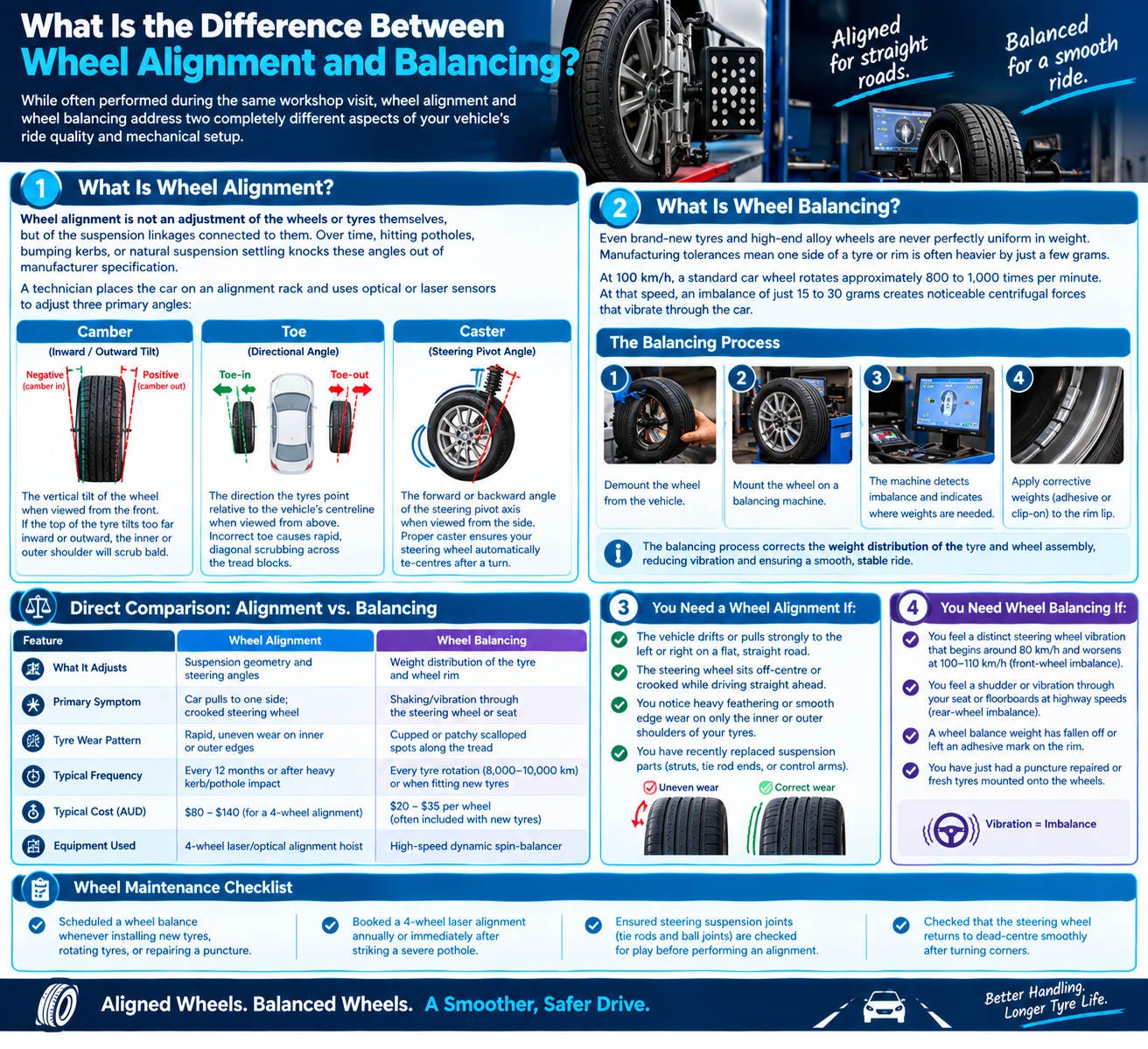
While often performed during the same workshop visit, wheel alignment and wheel balancing address two completely different aspects of your vehicle’s ride quality and mechanical setup.
- Wheel Alignment: Adjusts the angles of your vehicle’s suspension and steering components so your tyres roll straight and make proper contact with the road.
- Wheel Balancing: Corrects uneven weight distribution within the tyre and wheel assembly itself to prevent vibration as it spins.
1. What Is Wheel Alignment?
Wheel alignment is not an adjustment of the wheels or tyres themselves, but of the suspension linkages connected to them. Over time, hitting potholes, bumping kerbs, or natural suspension settling knocks these angles out of manufacturer specification.
A technician places the car on an alignment rack and uses optical or laser sensors to adjust three primary angles:
- Camber (Inward / Outward Tilt): The vertical tilt of the wheel when viewed from the front. If the top of the tyre tilts too far inward (negative camber) or outward (positive camber), the inner or outer shoulder of the tyre will scrub bald prematurely.
- Toe (Directional Angle): The direction the tyres point relative to the vehicle's centreline when viewed from above (toe-in points front edges toward each other; toe-out sways them apart). Incorrect toe causes rapid, diagonal scrubbing.
- Caster (Steering Pivot Angle): The forward or backward angle of the steering pivot axis when viewed from the side, ensuring your steering wheel automatically re-centres after making a turn.
2. What Is Wheel Balancing?
Even brand-new tyres and high-end alloy wheels are never perfectly uniform in weight due to manufacturing tolerances. At 100 km/h, a standard car wheel rotates 800 to 1,000 times per minute, meaning an imbalance of just 15 to 30 grams creates noticeable centrifugal forces that vibrate through the car.
- The Balancing Process: The wheel assembly is demounted and placed on a specialised dynamic balancing machine.
- Weight Application: The machine spins the wheel to pinpoint the exact spot where corrective counterweights (adhesive tape weights or clip-on weights) need to be affixed to the rim lip.
Direct Comparison: Alignment vs. Balancing
| Feature | Wheel Alignment | Wheel Balancing |
|---|---|---|
| What It Adjusts | Suspension geometry and steering angles | Weight distribution of the tyre and wheel rim |
| Primary Symptom | Car pulls to one side; crooked steering wheel | Shaking/vibration through the steering wheel or seat |
| Tyre Wear Pattern | Rapid, uneven wear on inner or outer edges | Cupped or patchy scalloped spots along the tread |
| Typical Frequency | Every 12 months or after heavy kerb/pothole impact | Every tyre rotation (8,000–10,000 km) or new tyres |
| Typical Cost (AUD) | $80 – $140 (for a 4-wheel alignment) | $20 – $35 per wheel (often included with new tyres) |
| Equipment Used | 4-wheel laser/optical alignment hoist | High-speed dynamic spin-balancer |
3. Symptoms: Which One Does Your Car Need?
You Need a Wheel Alignment If:
- The vehicle drifts or pulls strongly to the left or right when driving on a flat, straight road.
- The steering wheel sits off-centre or crooked while driving straight ahead.
- You notice heavy feathering or smooth edge wear on only the inner or outer shoulders of your tyres.
You Need Wheel Balancing If:
- You feel a distinct steering wheel vibration that begins around 80 km/h and worsens at 100–110 km/h.
- You feel a shudder or vibration through your seat or floorboards at highway speeds.
- A wheel balance weight has fallen off or you have just had a puncture repaired.
Wheel Maintenance Checklist
- Scheduled a wheel balance whenever installing new tyres, rotating tyres, or repairing a puncture.
- Booked a 4-wheel laser alignment annually or immediately after striking a severe pothole.
- Ensured steering suspension joints (tie rods and ball joints) are checked for play before an alignment.
- Checked that the steering wheel returns to dead-centre smoothly after turning corners.