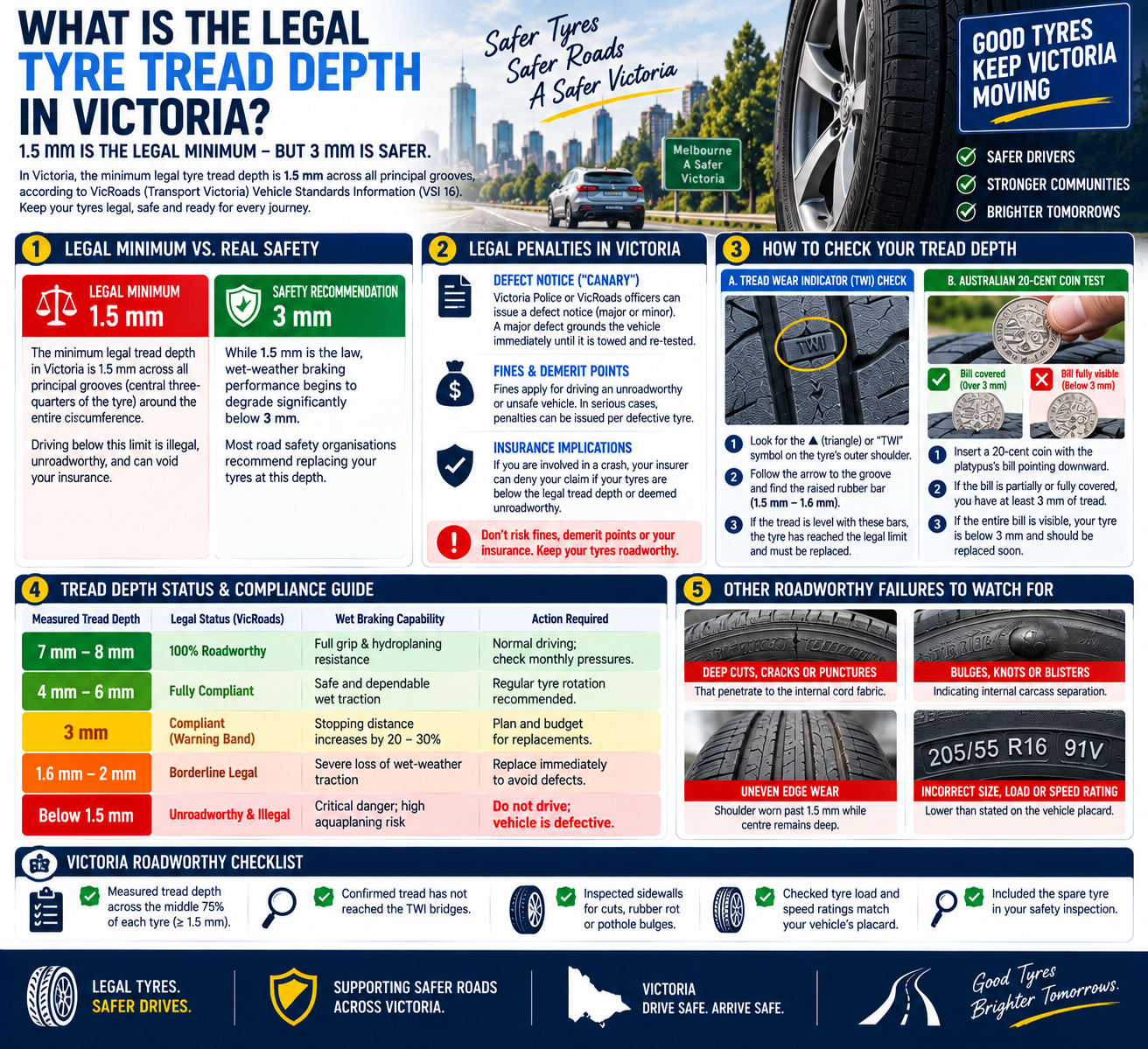
In Victoria, the minimum legal tyre tread depth is 1.5 mm. According to VicRoads (Transport Victoria) Vehicle Standards Information (VSI 16), this 1.5 mm minimum depth must be present across all principal grooves (the wide, circumferential drainage grooves in the central section of the tyre) around the entire circumference.
Driving on tyres worn below this threshold makes your vehicle legally unroadworthy, exposing you to police defect notices, fines, loss of demerit points, and potential insurance claim denials.
1. Legal Minimum (1.5 mm) vs. Real Safety (3 mm)
While 1.5 mm is the point where a tyre officially becomes illegal, it represents the absolute emergency boundary—not a safe operating standard:
- At 8 mm (New): Maximum water displacement; optimal hydroplaning resistance.
- At 3 mm (The Safety Recommendation): Wet-weather braking performance begins to degrade significantly. Most road safety organisations recommend replacing your tyres at this depth.
- At 1.5 mm (The Legal Limit): Emergency stopping distances in the wet can be up to doubled compared to new rubber, as the shallow grooves can no longer disperse standing water fast enough at freeway speeds.
2. Legal Penalties for Defective Tyres in Victoria
Driving with tyres below 1.5 mm or showing exposed cords carries serious consequences under Victorian road transport law:
- Defect Notice ("Canary"): Victoria Police or VicRoads transport officers can issue a defect notice (major or minor). A major defect notice grounds the vehicle immediately, prohibiting it from being driven until towed and re-tested by an authorised roadworthy inspector.
- On-the-Spot Fines & Demerit Points: Fines are issued for driving an unroadworthy or unsafe vehicle. In serious cases or multi-tyre violations, penalties can be issued per defective tyre.
- Insurance Implications: If you are involved in a collision—especially in wet conditions—an insurer can deny your claim if your vehicle is deemed unroadworthy due to worn-out rubber.
3. How to Check If Your Tyres Are Road-Legal in Victoria
A. The Tread Wear Indicator (TWI) Check
- Inspect the main circumferential grooves for raised rubber bars (set at 1.5 mm to 1.6 mm): Locate the small ▲ (triangle) or TWI symbol stamped on the tyre’s outer shoulder.
- Follow the line into the tread groove. If the outer tread surface has worn completely flush with these bars, the tyre has reached its legal limit and is no longer roadworthy.
B. The 20-Cent Coin Test
- Insert an Australian 20-cent coin into the central grooves with the platypus's bill pointing downward.
- Safe: If the platypus's bill is partially or completely submerged, you have over 3 mm of tread.
- Due for Replacement: If the entire bill is visible, tread is below 3 mm and approaching the legal boundary.
Tread Depth Status & Compliance Guide
| Measured Tread Depth | Legal Status (VicRoads) | Wet Braking Capability | Action Required |
|---|---|---|---|
| 7 mm – 8 mm | 100% Roadworthy | Full grip & hydroplaning resistance | Normal driving; check monthly pressures. |
| 4 mm – 6 mm | Fully Compliant | Safe and dependable wet traction | Regular tyre rotation recommended. |
| 3 mm | Compliant (Warning Band) | Stopping distance increases by 20–30% | Plan and budget for replacements. |
| 1.6 mm – 2 mm | Borderline Legal | Severe loss of wet-weather traction | Replace immediately to avoid defects. |
| Below 1.5 mm | Unroadworthy & Illegal | Critical danger; high aquaplaning risk | Do not drive; vehicle is defective. |
Other Roadworthy Failures to Watch For
Under VicRoads roadworthy standards, tread depth is not the only criterion. A tyre will instantly fail a Roadworthy Certificate (RWC) inspection if it has:
- Deep Damage: Any deep cut, crack, or puncture that penetrates to the internal cord fabric.
- Structural Bulges: Any visible bulge, knot, or blister in the sidewall (indicating internal carcass separation).
- Uneven Wear: Uneven edge wear that has scrubbed the shoulder down past 1.5 mm while the centre remains deep.
- Incorrect Specification: Incorrect size, load index, or speed rating lower than stated on the vehicle placard.
Victoria Roadworthy Checklist
- Measured tread depth across the middle 75% of each tyre to ensure it sits safely above 1.5 mm.
- Confirmed the tread has not reached the raised Tread Wear Indicator (TWI) bridges.
- Inspected all sidewalls for cuts, rubber rot, or pothole bulges.
- Checked that tyre load and speed ratings match the vehicle's door pillar placard.
- Included the spare tyre in your safety and tread depth inspection.