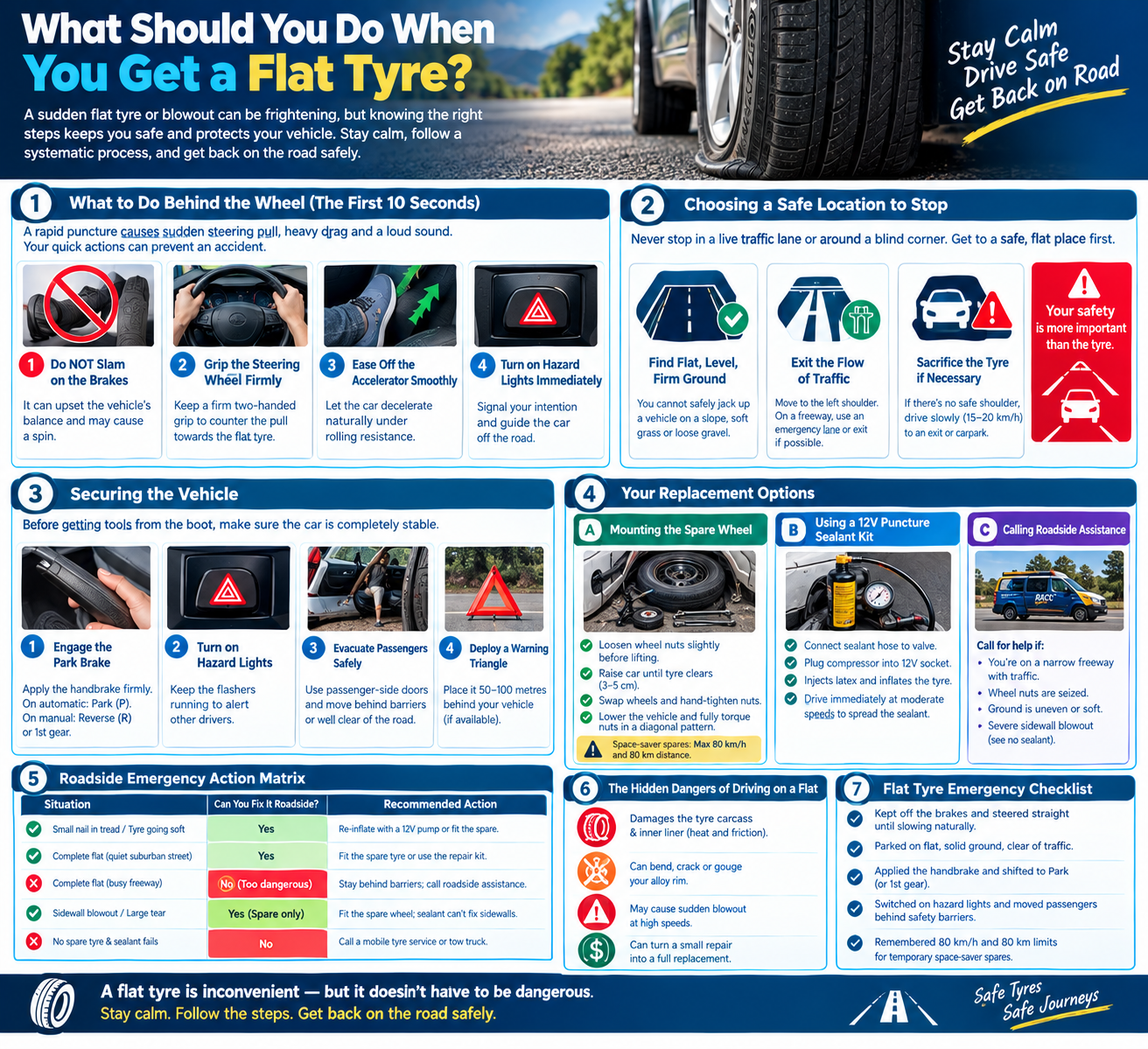
Experiencing a sudden flat tyre or rapid blowout at road speeds can be disorienting. How you handle the initial seconds behind the wheel dictates your safety, while your roadside actions determine whether the tyre can be repaired or if you risk damaging your vehicle’s wheel rim and suspension.
Keeping calm and following a systematic safety procedure ensures you reach a safe stopping point, protect your vehicle, and get back on the road safely.
1. What to Do Behind the Wheel (The First 10 Seconds)
A rapid puncture causes sudden steering pull, heavy vehicle drag, and a loud flapping or rumbling sound from the wheel arch:
- Do NOT Slam on the Brakes: Stamping on the brake pedal upsets the vehicle’s balance and can cause the car to pivot into an uncontrollable spin.
- Grip the Steering Wheel Firmly: Maintain a firm two-handed grip on the steering wheel to counter the vehicle's natural tendency to pull toward the side of the flat tyre.
- Ease Off the Accelerator Smoothly: Lift your foot off the throttle gradually to let the car decelerate naturally under rolling resistance.
- Signal and Guide the Car Off the Road: Turn on your hazard lights immediately, signal your intention, and steer smoothly toward the shoulder or an emergency breakdown bay.
2. Choosing a Safe Location to Stop
Never stop your car in an active traffic lane or around a blind corner just to inspect a tyre:
- Find Flat, Level, Firm Ground: You cannot safely jack up a vehicle on a slope, soft grass, or loose gravel; the jack can slip and drop the vehicle.
- Exit the Flow of Traffic: Move as far to the left shoulder as possible. On a busy freeway, stopping in a dedicated emergency breakdown lane or exiting the freeway completely is far safer than stopping near high-speed traffic.
- Sacrifice the Tyre if Necessary: If there is no safe emergency shoulder, it is better to drive slowly on the flat tyre at 15–20 km/h to reach an exit or carpark, as a damaged tyre or rim can be replaced while personal safety cannot.
3. Securing the Vehicle
Before retrieving tools from the boot, ensure the car is completely stable:
- Engage the Park Brake: Apply the handbrake firmly, shifting automatic vehicles into Park (P) or manual transmissions into Reverse (R) or 1st gear.
- Turn on Hazard Lights: Keep hazard warning flashers running to alert oncoming traffic.
- Evacuate Passengers Safely: Have passengers exit through passenger-side doors (away from traffic) and wait safely behind road barriers.
- Deploy a Warning Triangle: If available, place a reflective warning triangle 50 to 100 metres behind the vehicle.
4. Assessing Your Replacement Options
- Option A (Mounting the Spare Wheel): Loosen wheel nuts slightly before raising the car with the scissor jack, swap the wheels, lower the vehicle, and fully torque nuts in a star pattern. Note that space-saver spares have a maximum speed limit of 80 km/h and a driving limit of 80 km.
- Option B (Using a 12V Puncture Sealant Kit): Screw the canister hose to the valve and plug the compressor into the 12V socket to inject liquid latex and inflate the tyre simultaneously, sealing minor tread punctures up to 4–5 mm.
- Option C (Calling Roadside Assistance): Contact your provider if you are on a narrow freeway shoulder, wheel nuts are seized, ground conditions are unsafe, or the tyre has suffered a severe sidewall blowout.
Roadside Emergency Action Matrix
| Situation | Can You Fix It Roadside? | Recommended Course of Action |
|---|---|---|
| Small nail in tread / Tyre slowly going soft | Yes | Re-inflate with a 12V pump to drive to a shop, or fit the spare. |
| Complete flat on a quiet suburban street | Yes | Fit the spare tyre or use the tyre repair kit on flat ground. |
| Complete flat on a busy, narrow freeway | No (Too dangerous) | Stay behind safety barriers; call roadside assistance or highway patrol. |
| Sidewall blowout / Large tear in rubber | Yes (Spare only) | Fit the spare wheel; liquid puncture sealant cannot seal sidewalls. |
| No spare tyre and sealant kit fails to seal | No | Call a mobile tyre service van or arrange a tow truck to a tyre centre. |
Flat Tyre Emergency Checklist
- Kept off the brakes and steered straight until the vehicle slowed naturally.
- Parked on flat, solid ground well clear of active traffic lanes.
- Applied the handbrake firmly and shifted the transmission into Park (or 1st gear).
- Switched on hazard lights and moved passengers behind roadside safety barriers.
- Remembered the 80 km/h and 80 km operational limits if fitting a temporary space-saver spare.