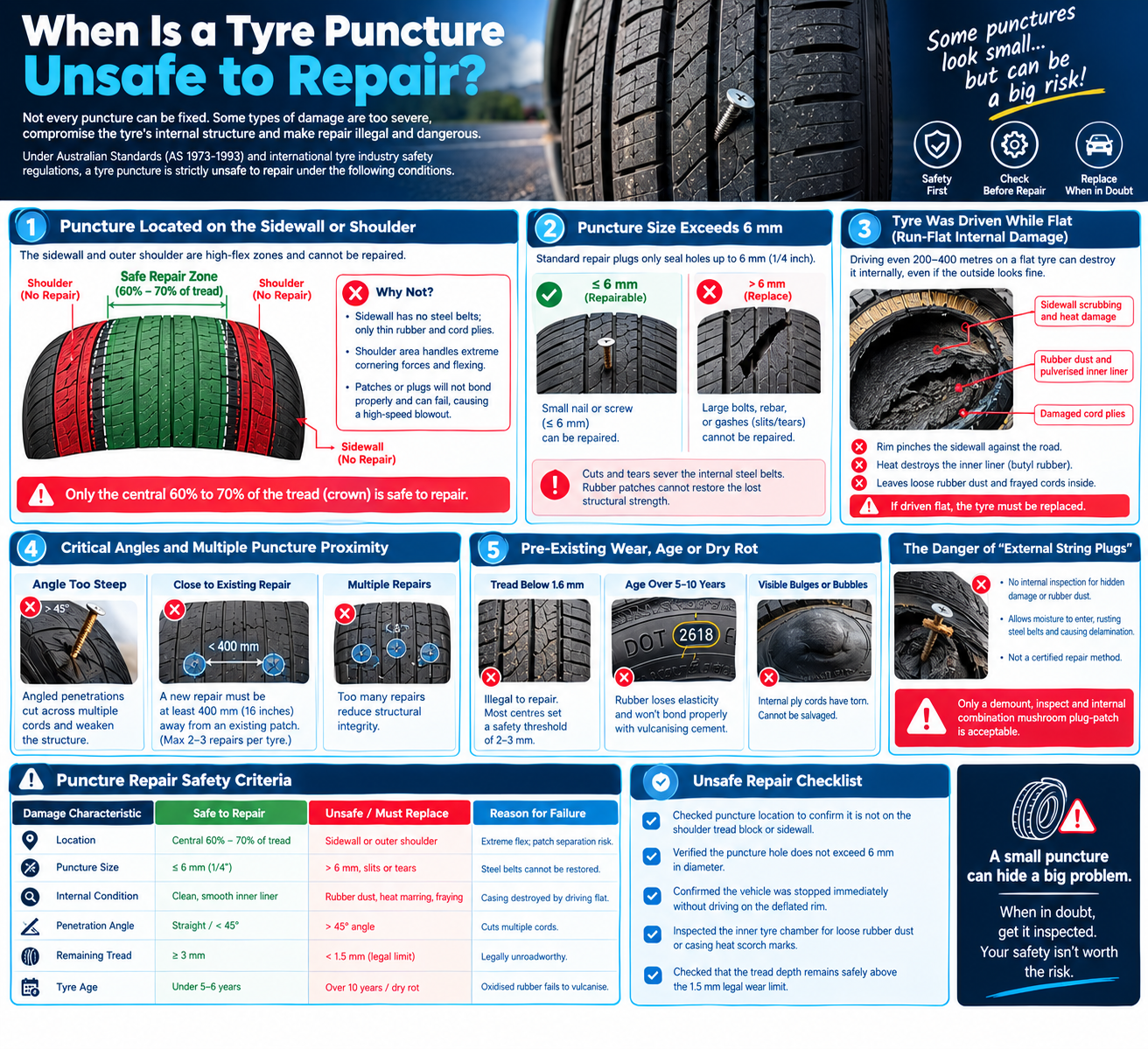
Discovering a screw or nail in your tyre often leads to a quick trip to the workshop in hopes of an inexpensive puncture repair. While many minor punctures can be permanently fixed, specific types of tyre damage compromise internal structural integrity so severely that any repair attempt becomes illegal and dangerous.
Under Australian Standards (AS 1973-1993) and international tyre industry safety regulations, a tyre puncture is strictly unsafe to repair under the following conditions.
1. Puncture Located on the Sidewall or Shoulder
The location of the damage is the most critical safety filter:
- The Sidewall: The sidewall carries no steel belts; it is composed of thin, flexible rubber and polyester or rayon cord plies that flex thousands of times every kilometre. A patch applied here cannot bond permanently, and any drilled stem will cause cords to separate, leading to a sudden highway blowout.
- The Outer Shoulder: The shoulder zone—roughly the outer 15% to 20% of the tread edge on both sides—absorbs extreme dynamic loads and lateral forces during turning, causing plugs or patches in this high-flex zone to work loose over time. Only punctures within the central 60% to 70% of the tread pattern (the crown) are safe to repair.
2. The Puncture Exceeds 6 mm in Diameter
- Hole Size Limits: Standard mushroom plug-patch units are certified to seal holes up to 6 mm (1/4 inch) across.
- Severe Cuts and Gashes: If a tyre is pierced by a large bolt, rebar, or jagged metal that slices a slit or tear into the tread, the internal high-tensile steel belts are severed and cannot be structurally restored by rubber patches.
3. The Tyre Was Driven While Flat (Run-Flat Internal Damage)
Driving even 200 to 400 metres on an uninflated tyre to get off a highway or reach a service station almost always destroys the tyre internally. Without air pressure to cushion the wheel, the heavy metal rim pinches the tyre sidewall against the road surface, creating extreme friction heat that burns the inner airtight butyl liner and leaves piles of loose black rubber dust inside the casing.
Tyre Repair Safety Criteria
| Damage Characteristic | Safe to Repair | Unsafe / Must Replace | Reason for Failure |
|---|---|---|---|
| Location | Central 60%–70% of tread | Sidewall or outer shoulder | Extreme structural flex; patch separation risk. |
| Puncture Size | 6 mm (1/4") or smaller | Greater than 6 mm, slits, or tears | Cut steel belts cannot be structurally restored. |
| Internal Condition | Clean, smooth inner liner | Rubber dust, heat marring, fraying | Casing destroyed by driving while under-inflated. |
| Penetration Angle | Straight / Under 45° | Greater than 45° angle | Drilled prep shears surrounding structural cords. |
| Remaining Tread | 3 mm or deeper | Below 1.6 mm (legal limit) | Legally unroadworthy regardless of puncture. |
| Tyre Age | Under 5–6 years old | Over 10 years / visible dry rot | Oxidised rubber fails to vulcanise to patch. |
4. The Danger of "External String Plugs"
Never rely on an external roadside string plug pushed through from the outside as a permanent fix. External rope plugs do not allow for internal casing inspection, and failure to seal the puncture channel simultaneously from both inside and outside allows moisture to seep in, causing the steel belts to rust and delaminate. A certified repair always requires demounting the tyre and inserting a one-piece combination mushroom plug-patch.
Unsafe Repair Checklist
- Checked puncture location to confirm it is not on the shoulder tread block or sidewall.
- Verified that the puncture hole does not exceed 6 mm in diameter.
- Confirmed the vehicle was stopped immediately without driving on the deflated rim.
- Inspected the inner tyre chamber for loose rubber dust or casing heat scorch marks.
- Checked that the tread depth remains safely above the 1.5 mm legal wear limit.