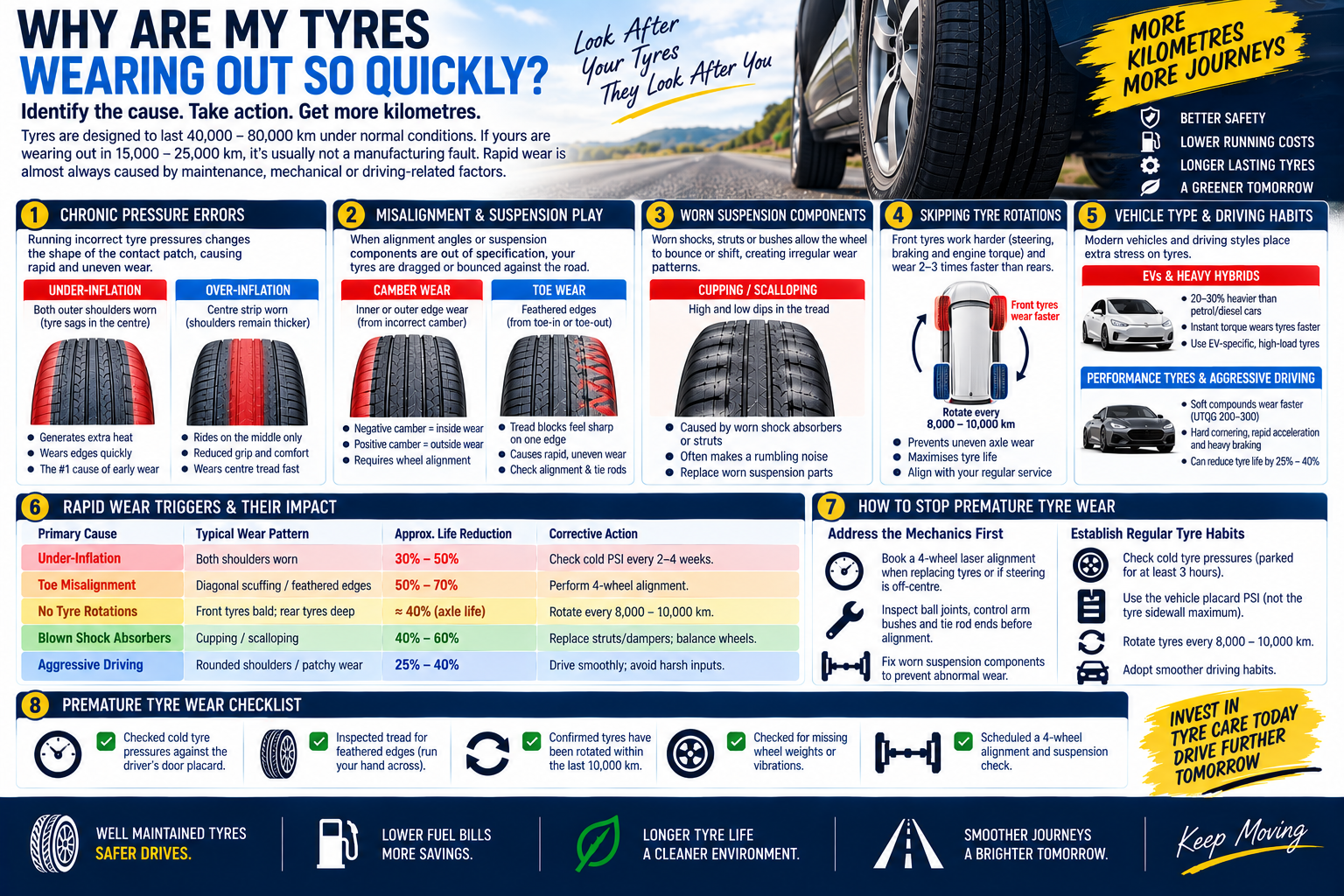
Tyres are engineered to deliver between 40,000 and 80,000 kilometres of dependable service under standard driving conditions. When a set burns through its usable tread in 15,000 to 25,000 kilometres, it is rarely due to a manufacturing defect.
Rapid, premature tyre wear is almost always caused by a combination of improper tyre maintenance, suspension misalignments, vehicle weight demands, or aggressive driving habits. Identifying the root cause early prevents burning through expensive rubber every service cycle.
1. Chronic Pressure Errors: Under- and Over-Inflation
Air pressure supports 95% of your vehicle's total weight; rubber merely encases it. Running incorrect pressures alters how the tyre contacts the road surface:
- Under-Inflation (The #1 Culprit): Driving with tyres 4 to 8 PSI below specification forces the centre of the tread to cup upward, shifting weight entirely to the outer shoulders and generating internal heat.
- Over-Inflation: Adding too much air balloons the tyre crown outward, forcing the vehicle to ride exclusively on the middle strip of tread.
2. Misalignment and Suspension Play
When suspension angles fall out of factory specification, tyres are dragged sideways across the tarmac:
- Toe Misalignment: Front tyres pointing inward or outward subject rubber to continuous lateral scrubbing, creating "feathered" tread edges.
- Camber Imbalance: Wheels tilted inward or outward grind the inner or outer shoulder down to the steel cords.
- Worn Shock Absorbers & Bushes: Degraded dampers allow the wheel to bounce uncontrolled, stamping out high and low depressions known as cupping or scalloping.
3. Skipping Routine Tyre Rotations
In Front-Wheel Drive (FWD) vehicles, the front axle handles steering angles, weight transfer under heavy braking, and engine torque delivery simultaneously, causing front tyres to wear down two to three times faster than rear tyres. Skipping front-to-rear rotations results in completely bald front tyres while the rear pair still retains 60% tread.
4. Vehicle Type and Tyre Compound Mismatches
- Electric Vehicles (EVs) & Heavy Hybrids: EVs are roughly 20–30% heavier and deliver instantaneous torque, accelerating standard rubber wear without specialized high-load compounds.
- Ultra-High Performance (UHP) Compounds: Soft, sticky synthetic resins designed for track grip have low UTQG treadwear ratings (200–300), wearing down twice as fast as durable touring tyres.
Rapid Wear Triggers & Their Impact
| Primary Cause | Typical Wear Pattern | Approximate Life Reduction | Corrective Action |
|---|---|---|---|
| Under-Inflation | Both outer and inner shoulders worn bald | 30% – 50% | Check cold PSI every 2 to 4 weeks against door placard. |
| Toe Misalignment | Diagonal scuffing; feathered sawtooth edges | 50% – 70% | Perform 4-wheel computer alignment. |
| No Tyre Rotations | Front tyres bald; rear tyres deep | 40% (axle life) | Rotate tyres front-to-back every 8,000–10,000 km. |
| Blown Shock Absorbers | Scalloped hollows, rhythmic cabin thrum | 40% – 60% | Replace failing struts/dampers and balance wheels. |
| Aggressive Driving | Rounded outer shoulders; patchy flat spots | 25% – 40% | Smooth out cornering speeds and heavy braking inputs. |
Premature Tyre Wear Checklist
- Checked cold tyre pressures across all four tyres against the driver's door placard.
- Inspected tread surfaces for feathered edges by running a gloved hand across each block.
- Confirmed tyres have been rotated within the last 10,000 kilometres.
- Inspected wheels for missing balancing wheel weights or steering wheel vibration.
- Scheduled a 4-wheel alignment and suspension check to eliminate steering drag.