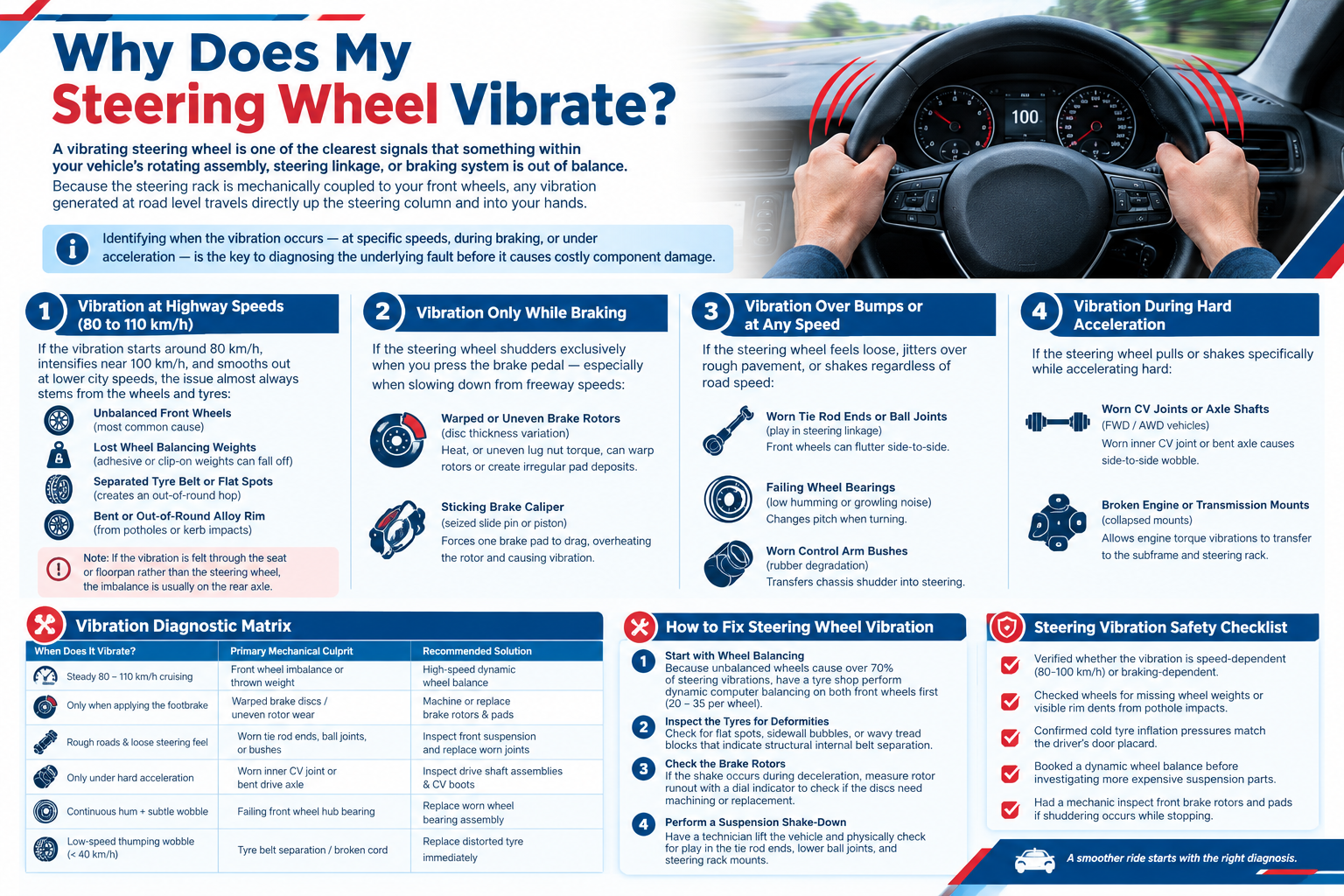
A vibrating steering wheel is one of the clearest signals that something within your vehicle's rotating assembly, steering linkage, or braking system is out of balance. Because the steering rack is mechanically coupled to your front wheels, any vibration generated at road level travels directly up the steering column and into your hands.
Identifying when the vibration occurs—at specific speeds, during braking, or under acceleration—is the key to diagnosing the underlying fault before it causes costly component damage.
1. Vibration at Highway Speeds (80 to 110 km/h)
If the vibration starts around 80 km/h, intensifies near 100 km/h, and smooths out at lower city speeds, the issue almost always stems from the wheels and tyres:
- Unbalanced Front Wheels: Even a minor weight variance of 10 to 20 grams causes the wheel assembly to bounce or wobble violently as it spins hundreds of times per minute at freeway speeds. (Note: If felt through the seat or floorpan, the imbalance is usually on the rear axle).
- Lost Wheel Balancing Weights: Adhesive or clip-on wheel weights can fall off after washing wheels or driving over rough terrain.
- Separated Tyre Belt or Flat Spots: Internal steel belt separation creates an "out-of-round" hop that balancing machines cannot eliminate.
- Bent Alloy Rim: Striking a severe pothole bends the wheel barrel or lip, inducing high-speed vibration.
2. Vibration Only While Braking
If the steering wheel shudders exclusively when you press the brake pedal—especially when slowing down from freeway speeds, it points directly to warped or uneven brake rotors (disc thickness variation) caused by extreme heat or uneven lug nut torque, or a sticking brake caliper causing pads to drag continuously.
3. Vibration Over Bumps or at Any Speed
If the steering wheel feels loose, jitters over rough pavement, or shakes regardless of your road speed, inspect for worn tie rod ends or ball joints (slack in internal ball sockets causing front wheels to flutter), failing wheel bearings (accompanied by a rhythmic humming noise), or degraded rubber control arm bushes.
Steering Vibration Diagnostic Matrix
| When Does It Vibrate? | Primary Mechanical Culprit | Recommended Solution |
|---|---|---|
| Steady 80 – 110 km/h cruising | Front wheel imbalance or thrown weight | High-speed dynamic wheel balance |
| Only when applying the footbrake | Warped brake discs / uneven rotor wear | Machine or replace brake rotors & pads |
| Rough roads & loose steering feel | Worn tie rod ends, ball joints, or bushes | Inspect front suspension and replace worn joints |
| Only under hard acceleration | Worn inner CV joint or bent drive axle | Inspect drive shaft assemblies & CV boots |
| Continuous hum + subtle steering wobble | Failing front wheel hub bearing | Replace worn wheel bearing assembly |
| Low-speed thumping wobble (< 40 km/h) | Internal tyre belt separation / broken cord | Replace distorted tyre immediately |
How to Fix Steering Wheel Vibration
- Start with Wheel Balancing: Because unbalanced wheels cause over 70% of steering vibrations, have a tyre shop perform dynamic computer balancing on both front wheels first.
- Inspect Tyres for Deformities: Check for flat spots, sidewall bubbles, or wavy tread blocks indicating internal belt separation.
- Check Brake Rotors: Measure rotor runout with a dial indicator if the shake occurs during deceleration.
- Perform a Suspension Shake-Down: Have a technician check for play in tie rod ends, lower ball joints, and steering rack mounts.
Steering Vibration Safety Checklist
- Verified whether the vibration is speed-dependent (80–100 km/h) or braking-dependent.
- Checked wheels for missing wheel weights or visible rim dents from pothole impacts.
- Confirmed cold tyre inflation pressures match the driver's door placard.
- Booked a dynamic wheel balance before investigating more expensive suspension parts.
- Had a mechanic inspect front brake rotors and pads if shuddering occurs while stopping.